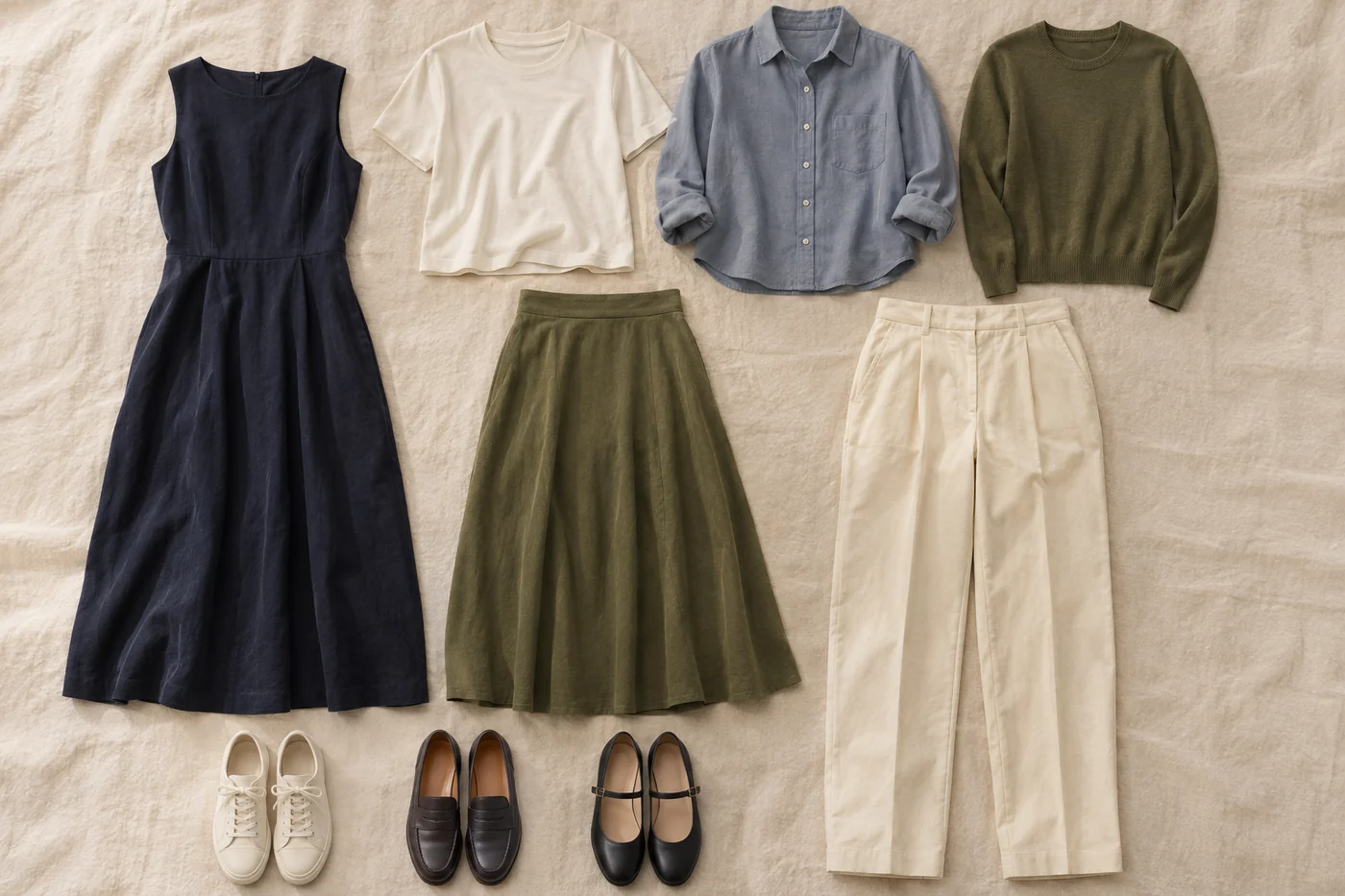
An outfit formula is a relationship you can reuse, such as a short layer above a long lower line, or a soft top inside a more structured frame. It is more useful than a list of colors because it explains why a combination feels familiar even when some clothes change.
Repeating a formula can make everyday dressing easier without requiring identical outfits. Start by naming the stable relationship, then change one or two features that matter to you. Keep the actual garments, activity and comfort in the decision; a formula is a starting point rather than a guarantee that every substitution will work.
Describe the relationship before naming the products
Choose an outfit you already like and write a short description. A compact knit above full-length wide trousers is more informative than sweater and pants. A long open shirt around a plain dress is more informative than casual layers. Include the feature you would most like to keep.
You might enjoy a visible waistband, an uninterrupted dark line or a contrast between a broad upper shape and a narrower bottom. None is a rule for your body. The description should explain your preference clearly enough that you can recognise another version in your wardrobe.
Example one: keep the short-over-long structure
Begin with a short cardigan, wide trousers and loafers. For a second look, use a short jacket over a plain tee with the same trousers. The main upper boundary stays compact, but the jacket introduces a clearer frame and another neckline. Inspect whether the tee hem supports or complicates that boundary.
For a third version, use the short cardigan with a long skirt and flats. The lower line now moves differently, so test stride and seated comfort. This is a related formula with a different garment structure, not proof that every trouser outfit can be transferred unchanged to a skirt.
Example two: keep an open frame around a quiet base
Use a long open overshirt over a plain top and straight trousers. Then compare a long cardigan over a dress with familiar shoes. The two open edges remain the organising idea while the base changes from separate garments to one piece.
If you want another version, try a shorter open layer and observe what changes. It may become a different formula you prefer. Repetition does not require preserving a relationship after it stops serving the garment. Save the successful change with a new description rather than forcing every experiment into the original category.
Change the surface without inventing the material
A visibly smooth base beneath a textured-looking layer gives you one kind of variation. Pattern scale, a washed color and a finer or broader rib can alter the effect while keeping the main lengths similar. Use the clothes’ labels for fibre facts; describe a reference image through its visible surface.
A charcoal tee and black trousers can be distinct from a white shirt and dark trousers even within the same proportions, because the neckline, contrast and fastening change. A different color alone can also be meaningful to you. The point is to describe the change accurately rather than inflate a capsule count with untested swaps.
Change formality through the actual setting
With a plain shirt and straight trousers, compare everyday sneakers and loafers you own. Check the hem again, because the shoe shape and height can alter where it lands. Keep the version appropriate to your workplace or event. A more polished-looking shoe cannot overrule a specific dress requirement.
You can also change the top role: a collared shirt, a plain knit or a tee inside the same soft jacket. Inspect collar and sleeve space rather than assuming those bases are interchangeable. If the substitute needs a different jacket or different trousers, record the larger change instead of hiding it under the formula name.
Save families of outfits, then plan the real version
Build separate boards for the variants you would use. Name the family by its relationship and the version by its actual pieces: short-over-long, cardigan and skirt, for example. This lets you find the idea later while preserving the specific outfit you chose.
Use the planner for the version you intend to wear on a particular day. Consider weather, laundering and the availability of repeated pieces. After wearing it, keep a short observation about what held the formula together. Over time, a few well-described families can offer more useful variety than a large collection of outfits you cannot explain or comfortably repeat.
Put the idea to work