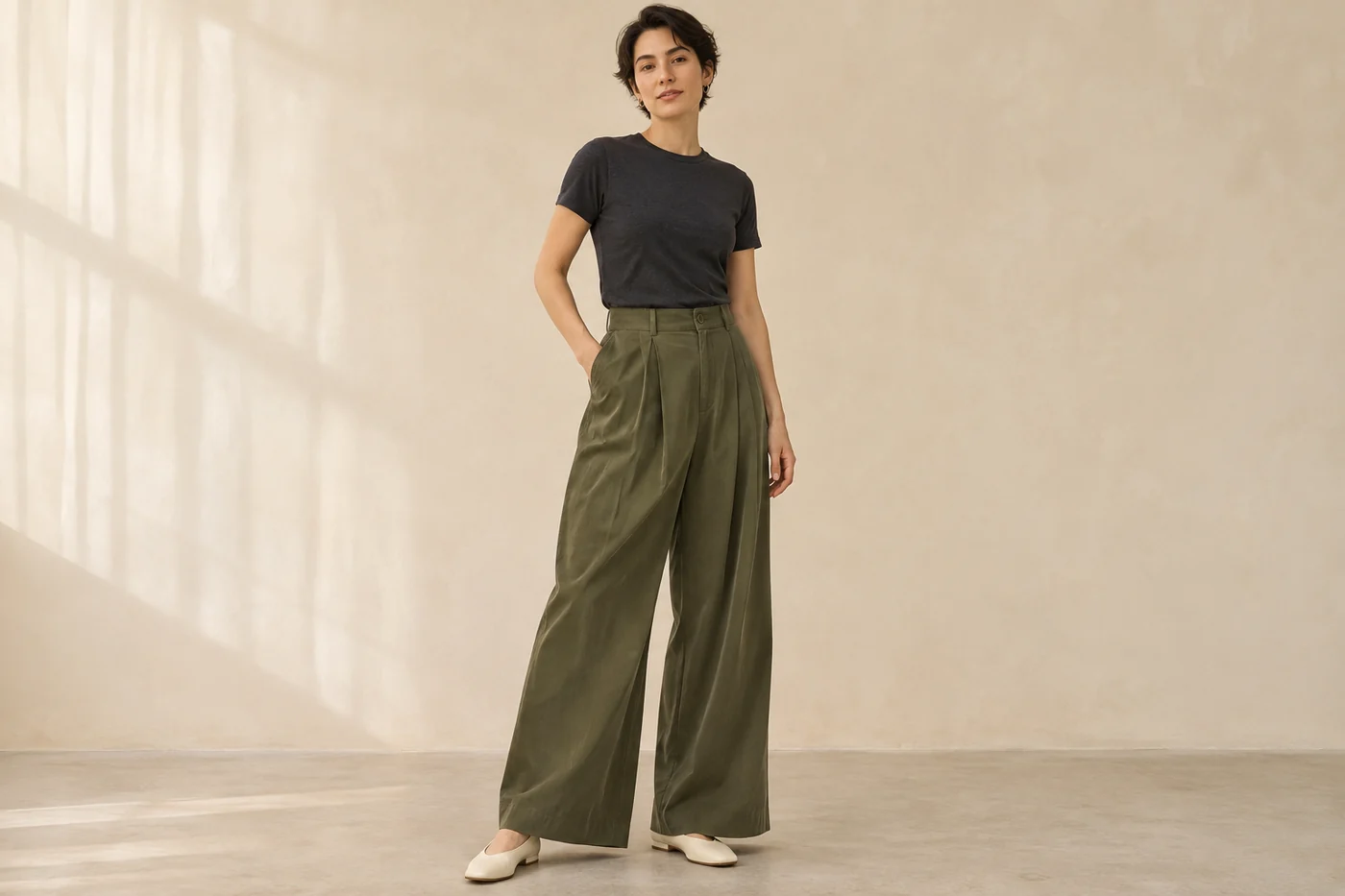
Straight, wide and barrel describe different parts of a trouser outline, but they are not standardized measurements. Compare where the leg is fullest and how it arrives at the ankle. Then look at the top and shoe together: replacing a straight trouser with a curved one can change the outfit even when every color stays the same.
The most useful comparison starts with trousers that fit comfortably. You are choosing a design relationship, not ranking which leg shape is best for your body. Three workable formulas make the differences easier to see.
Separate the label from the actual shape
COS describes its straight trousers as straight at the ankle, its wide trousers as loose through the legs, and its barrel trousers as curved through the leg and narrower toward the ankle. That is a useful example of one brand's vocabulary. It does not guarantee that another maker's straight or barrel shape has the same dimensions.
Compare the waist position, thigh room, knee shape, leg opening and length separately. Relaxed usually tells you something about ease, but it does not identify the entire outline. A straight trouser can be roomy; a barrel trouser can have a relatively narrow opening. Read the garment measurements and inspect front and side views.
Straight legs: use the clear line as a quiet base
Try straight dark-blue trousers, a cream tee, a brown cardigan and low loafers. The trouser gives the eye a fairly continuous route from upper leg to hem. That lets the cardigan's texture or opening take more of the attention. A light break can keep the foot visible without demanding a cropped leg.
If you prefer a longer shirt, straight trousers are also a useful testing base because the upper and lower outlines need not compete strongly. Compare the cardigan closed and open. This changes the center of the outfit while leaving the trousers' job intact. The formula is quiet because of those choices, not because straight trousers are inherently formal.
Wide legs: make the hem and top boundary deliberate
Try charcoal wide trousers, a blue boxy shirt and substantial black lace-up shoes. Let the shirt end around the high hip or tuck it loosely if you want more rise visible. Here the broad lower line is the main shape. A simple upper surface gives it room without requiring a fitted top.
Check the hem over the real shoe. Extra length can create a soft pool or an unwanted pile depending on the fabric and opening. A smaller shoe may become almost hidden; a larger one may catch more fabric. Choose the amount of shoe you want to see rather than treating chunky footwear as a mandatory partner.
Barrel legs: show enough outline to read the curve
Try olive barrel trousers with a black close-fitting crewneck, an open short jacket and black Mary Janes or compact sneakers. The quieter top lets the curved leg outline remain visible. A hem that clears the shoe can emphasize the narrowing opening, but the preferred gap depends on the actual trouser, shoe and socks.
For an all-relaxed version, replace the close-fitting top with a roomy cropped sweatshirt. You retain a clear upper endpoint while changing the feel. If the trouser shape disappears under a long, wide shirt, decide whether you enjoy that broader outline. Revealing the barrel is an option, not a requirement to prove that you bought the correct cut.
Length can change the apparent category
A long barrel trouser gathering at the ankle may look less curved than its flat product image. A wide trouser folded into a large cuff may look shorter and firmer. A straight leg in a fluid fabric can move away from the body more than a stiff photograph suggests. None of those observations means the manufacturer's name is necessarily wrong.
Use a full-length mirror and take a few ordinary steps. Check the side view, especially if fabric balloons at the knee or catches at the calf. If you are considering alterations, show the tailor the desired shoes and discuss what changing the length would do to the intended outline. A hem change cannot automatically reproduce a different pattern.
Compare without changing five things at once
A simple exercise uses one plain tee and one shoe with all three trousers. Keep the tee arrangement and camera position consistent. Note what changes at the hip, knee and ankle. Then adjust the top for each trouser, so you can distinguish the shape comparison from your final styling preference.
For example, the straight pair may work with the tee untucked, the wide pair with a loose tuck, and the barrel pair with the tee beneath an open short jacket. Those are three different solutions using a shared base. They explain more than three photographs that also change color, pose, footwear and outerwear.
Choose the role missing from your wardrobe
Before buying another shape, ask what it would allow you to do. A wide trouser could offer a generous lower silhouette; a barrel could introduce a curved one; another straight pair could replace a worn everyday favorite. A new category name alone is not a wardrobe gap.
Save the dimensions of a pair you enjoy, then compare a candidate using the same measuring method. Use the outfit builder to try the new outline with your existing tops. Keep size labels, actual measurements and personal preference separate: a well-documented comparison reduces guesswork but cannot guarantee the feel of an untried garment.
Put the idea to work
Your wardrobe. Your version.
Sources and scope.
What this article can establish
- Outfit formulas are editorial proposals, not photographs of exact purchasable sets or results from a wear test.