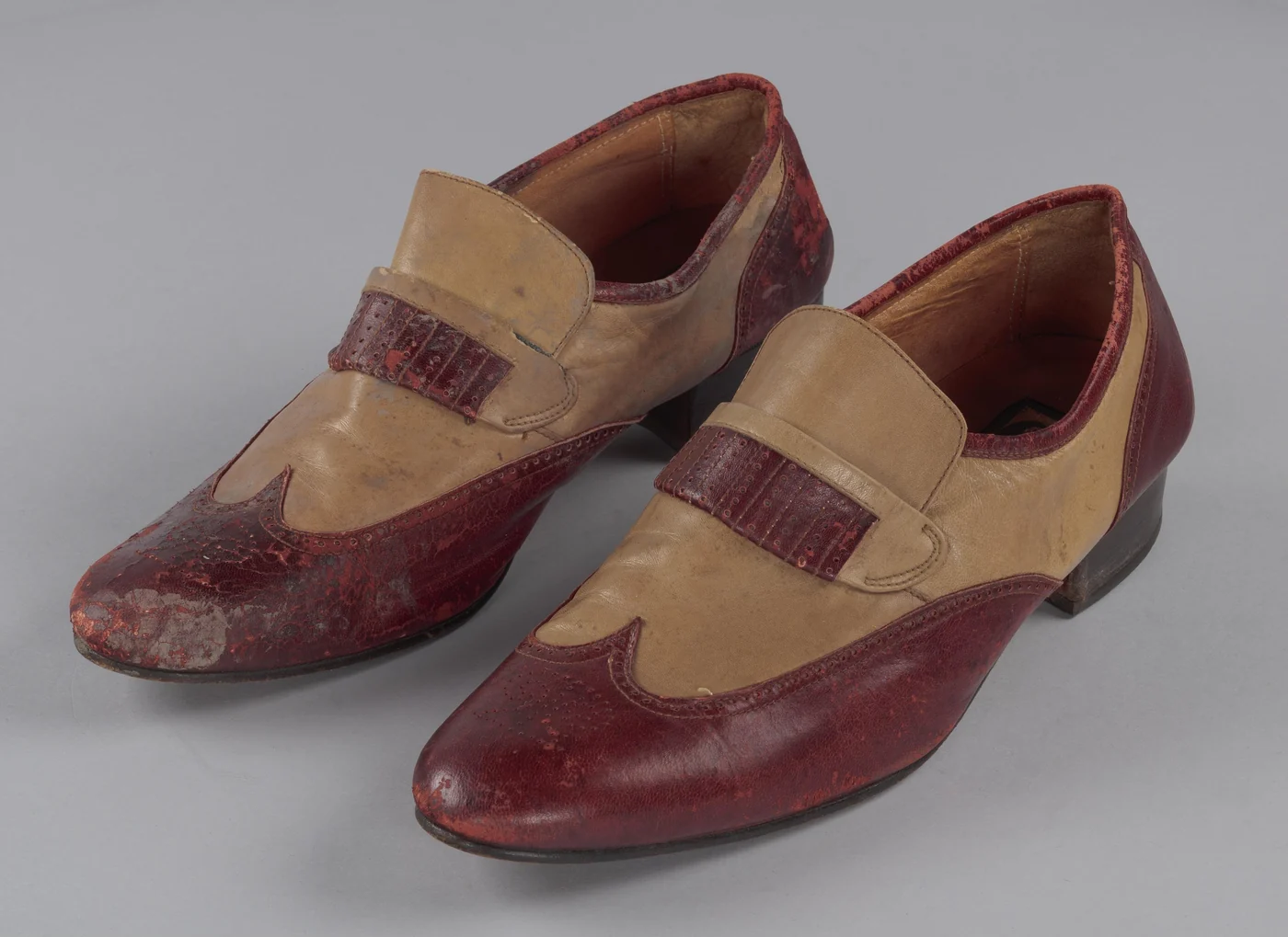
Penny, tassel and horsebit describe familiar treatments across the front of a loafer. They help you identify the design language, but they do not tell you everything about the shoe. Toe shape, vamp height, sole outline and the actual construction can change the result as much as the decoration.
The categories also carry brand histories worth keeping specific. A dated launch is evidence about that product, not proof that every similar slip-on shares its materials, fit or method of manufacture. Start with the visible form, then follow the exact reference you are comparing.
Penny: look for the saddle across the vamp
On the familiar penny form, a saddle-like strip crosses the upper with a small opening. G.H.BASS dates its Weejuns introduction to 1936 and relates the name and design to Norwegian moccasin references. That is the company’s documented account of its model, rather than a complete history of every earlier slip-on shoe.
The opening and strap make a strong horizontal detail. On a plain dark shoe, that can be quieter than contrasting hardware; on a two-tone version, it can become a larger visual feature. Inspect the particular shoe instead of assuming every penny loafer has the same level of formality or the same amount of visual weight.
Tassel: distinguish ornament from a working lace
The tassel form uses hanging leather details at the vamp. Alden’s manufacturing catalogue documents its Tassel Moccasin in several leathers and on a named last. That is direct evidence of a maker’s defined product family. It is not necessary to repeat an unsourced actor anecdote or a universal invention date to understand the form.
Look at whether the tassels sit on a plain front, a strap or additional seam detailing. Small changes can make the upper appear busier or more restrained. Do not treat a decorative cord as an adjustable closure unless the maker actually describes it that way. For fit, the whole shoe and its last still matter.
Horsebit: a named emblem and a broader resemblance
Gucci dates its Horsebit loafer to 1953 and identifies the metal detail with an equestrian reference. Keep that named model distinct from the broader category of metal-trimmed loafers. Similar hardware does not establish that a different shoe is a Gucci product, an authorised collaboration or built by the same method.
Hardware can catch light and introduce another material near the trouser hem or bare ankle. If you want that to be the main accent, a quieter trouser and fewer competing accessories may make it easier to read. That is a composition choice, not a rule requiring every metal detail in an outfit to match exactly.
The rest of the shoe can outweigh the category name
Compare three things beyond the vamp ornament: toe outline, upper coverage and sole profile. A broad rounded penny loafer on a thick sole may appear heavier than a narrow tassel loafer on a quieter sole. A metal bit does not automatically make a shoe the most conspicuous of the three.
Use exact model descriptions and comparable views. A photographed side profile can help assess the outline, but it does not measure internal space, underfoot comfort or flexibility. Keep construction terms such as welted or cemented tied to the maker’s actual specification; none of the three decorative categories guarantees one construction system.
Use a consistent outfit to reveal the difference
For a practical comparison, keep the same straight dark trousers and plain shirt, then test each loafer form. Look at how much upper is exposed and where the hem touches the shoe. If most of the vamp disappears, the sole and toe may dominate more than the difference between a penny opening and a tassel.
Now compare a cropped trouser or a skirt, where more of the upper is visible. The detail can become clearer without changing the shoe. This explains why shopping from an isolated packshot can be misleading for styling: the part you admire may be hidden in the outfit you intend to wear.
Choose by role, then verify fit and care
Decide whether you want a quiet dark endpoint, a visible upper detail or a fuller shoe to sit under a wider hem. Search for the exact models that perform that visual role, then check their size guidance, materials and care instructions. A familiar loafer category is not a universal sizing conversion.
If you already own one form, try it in the intended outfit before adding another. A different decoration may be appealing without producing a new role. When the difference is meaningful, record what changes: more visible hardware, a broader toe or a lower-looking sole. That makes the comparison useful beyond the prestige of a historical name.
Put the idea to work
Your wardrobe. Your version.
Sources and scope.
- G.H.BASS — Our Story
- Alden — New England Footwear Catalogue
- Gucci — 70 Years of the Horsebit Loafer
- Gucci — Making the Horsebit Loafer
What this article can establish
- Penny, tassel and horsebit describe design details, not universal construction or fit categories. No actor anecdote or unverified tassel invention date is repeated.