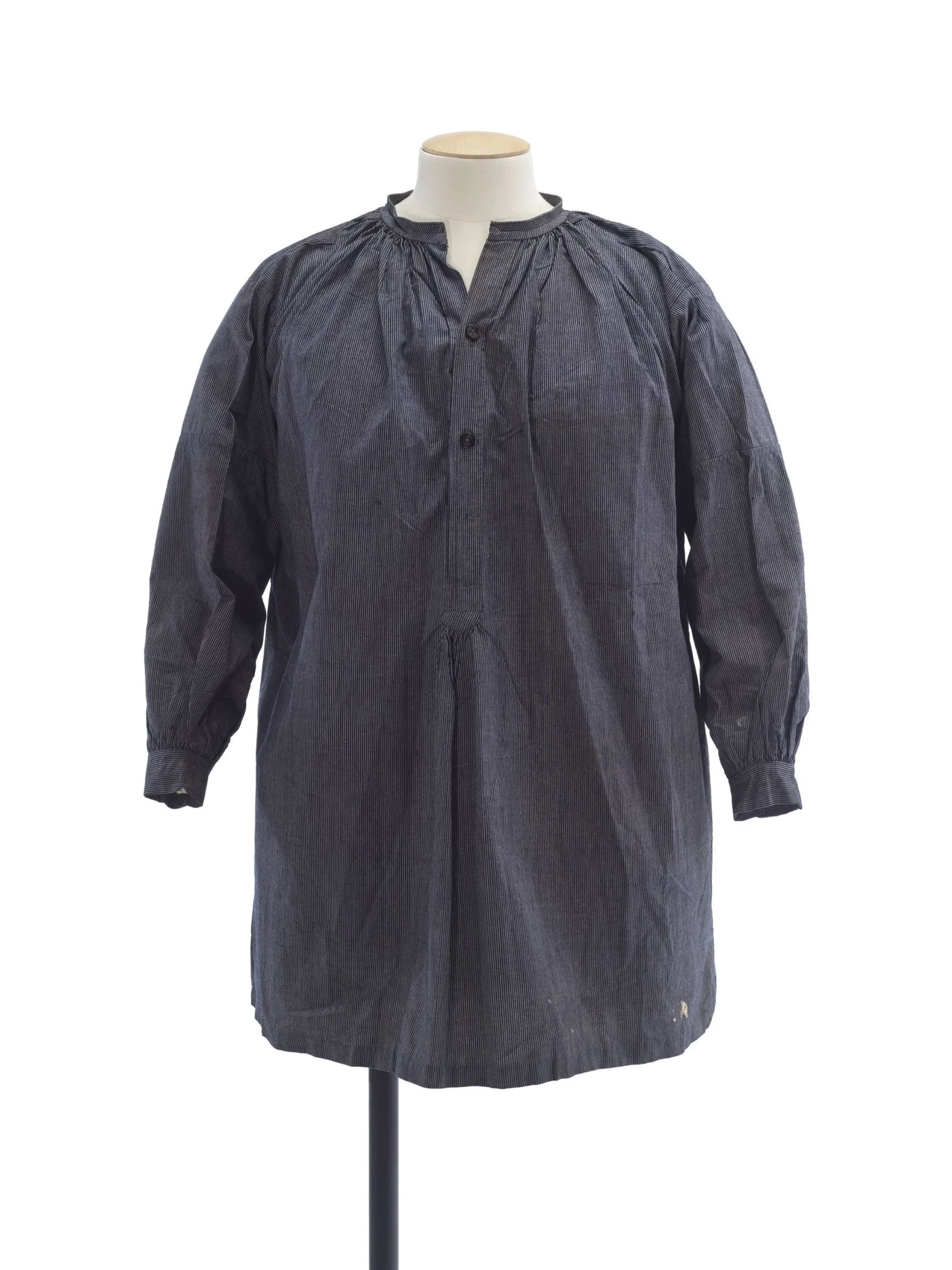
Workwear enters an everyday wardrobe through both its construction and the meanings people give it. A generous pocket, reinforced stress point or roomy layer can remain useful after the wearer’s job changes. At the same time, music, leisure, fashion and personal styling can turn an occupational reference into a different kind of expression.
There is no single moment when all work clothes became fashion. Denim offers a particularly well-documented route, while later adaptations show that a familiar workwear outline can become a new collection with different cuts and audiences. Understanding those changes is more useful than assuming every utility-looking jacket performs the same job.
Begin before the famous patent
The Museum at FIT’s Denim: Fashion’s Frontier includes work trousers from before Levi Strauss & Co.’s riveted-jeans patent and a nineteenth-century woman’s denim work jacket. Those objects complicate a story often reduced to one men’s trouser. Denim was already serving different garments and wearers before the most familiar brand milestone.
The distinction matters when looking at a modern piece. A woven cotton fabric, a riveted trouser construction and a complete work uniform are related ideas, but they are not the same invention. Keeping those layers separate makes room for the workers, makers and garments left out of a simple origin slogan.
Read reinforcement as a solution to a particular problem
Levi Strauss & Co.’s archive records the 1873 patent awarded to Jacob Davis and Levi Strauss for riveted work pants. The specific intervention was reinforcement at stress points. That is a more precise historical claim than saying the company invented every form of denim clothing or every pair of trousers used for work.
In an everyday outfit, a rivet may now read as a familiar visual detail. You can appreciate its origin without assuming a modern fashion version meets an occupational safety requirement. Likewise, a large pocket may be practical for a phone, but its presence does not establish the garment’s durability, protection or suitability for a particular trade.
Adoption changes the context, not just the wearer
Carhartt WIP describes its collections as adaptations of Carhartt workwear, established under Edwin Faeh in 1994 and connected with skateboarding, music and other cultural communities. That is the brand’s documented account of its own development, rather than a complete explanation for why every person adopted utility clothing.
The useful point is the deliberate adaptation. A contemporary collection can retain a patch pocket or robust-looking outline while changing fit, colour, fabrication or styling. Treat the original occupational garment and the later fashion interpretation as specific objects to compare. A shared logo or family name should not erase their differences.
Notice what survives when the job disappears
A short work-jacket shape offers a clear upper boundary above wider trousers. A plain front can support a patterned shirt without competing with it. Patch pockets break up a broad surface. These are visual reasons to enjoy a workwear reference even when you do not need the original function.
The same detail can do two jobs in your own wardrobe. A pocket can hold something and create a block of texture; a roomy cut can allow a layer and produce a generous silhouette. Look at the actual dimensions and construction before deciding which role matters. Function inherited in appearance is not always function inherited in performance.
Try a small translation rather than a whole costume
For an everyday example, start with an owned plain tee, straight trousers and familiar low shoes. Add a chore-jacket-style layer and examine its hem against the trouser rise. If the jacket is boxy and pocketed, keeping the lower half quieter lets those details be legible. The result can reference workwear without recreating a uniform.
For a second version, keep the same layer and use a skirt or a dress whose length gives the jacket a clear endpoint. There is no historical rule that utility clothing belongs to one gender or one bottom shape. The Museum at FIT’s wider denim history is a reminder to look beyond a narrow modern stereotype.
Keep the history specific when shopping
Ask which part of a new piece attracts you: cloth, pocket arrangement, body length, brand association or a particular archive reference. Then compare that feature with clothes you already own. A jacket may supply the desired outline without requiring matching carpenter trousers, heavy boots and a new set of accessories.
When the product makes a performance claim, read its own documentation. When it makes a heritage claim, look for the named reference and what has changed. This approach lets history enrich a wardrobe decision while leaving room for contemporary needs, personal expression and the choice to use a piece simply because its shape works well.
Put the idea to work
Your wardrobe. Your version.
Sources and scope.
- The Museum at FIT — Denim: Fashion’s Frontier
- Levi Strauss & Co. — The History of Denim
- Carhartt WIP — History
What this article can establish
- Selected denim and Carhartt WIP examples do not constitute a universal history of occupational clothing. Heritage details do not establish current work or safety performance.