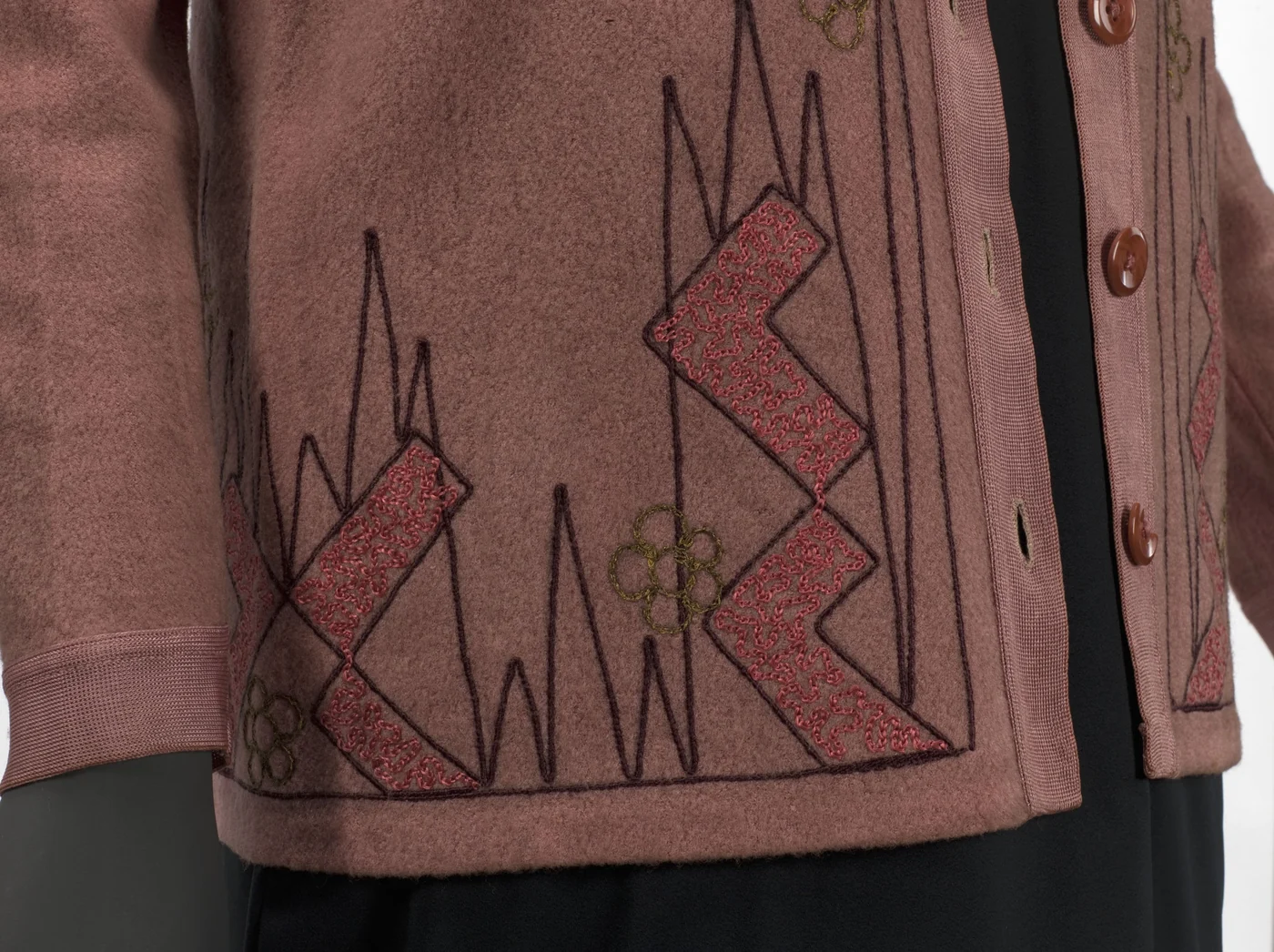
A cardigan changes an outfit through a simple structural fact: its front opens. Buttoned, it can work as the main top; open, it makes a frame for another layer. Body length, neckline, gauge and the way the front hangs give that structure very different expressions.
That versatility sits within a wider history of knitwear moving through sport, everyday dress and designed fashion. The cardigan has not belonged to only one age, gender or social setting. Looking at specific objects and uses gives a more useful history than attaching it permanently to a single character.
Place the cardigan within knitwear’s changing role
The V&A’s sweater history documents a late-nineteenth-century expansion of knitwear for activities including golf, boating, tennis and cycling, followed by growing fashion use in the 1920s and 1930s. This is a broader knitwear history, not evidence that every cardigan began as the same sports garment.
The functional link is still useful to consider: knitted garments can be designed for movement and layering, while the opening front gives a wearer another way to adjust an ensemble. Whether a particular modern knit is warm, elastic or suitable for an activity depends on its own material and construction, not on the category’s sporting associations.
A museum ensemble shows one fashion transformation
The Kyoto Costume Institute’s record of a Chanel day ensemble from about 1928 describes a cardigan-and-skirt combination and relates it to the designer’s jersey separates. That documented object shows how an opening layer could participate in a composed day outfit, rather than existing only as something added for extra warmth.
It does not establish that Chanel invented every cardigan or that the piece had no earlier wearers. A single museum object is strongest when used for what it can show: a dated example, named maker, material record and arrangement of garments. The larger history remains broader than one designer’s contribution.
The surface can be quiet or highly expressive
The V&A’s hand-knitting history includes Patricia Roberts’s Romany cardigan from 1982, described through its contrasting stitches, colour and patchwork effect. That example sits far from the image of a plain, conservative layer. A familiar opening-front construction can carry ambitious textile design.
When choosing a cardigan for an outfit, decide whether its surface or its outline is doing the main work. A busy stitch pattern may be clearest with a quiet base. A plain fine-looking knit can leave more attention for the collar underneath or the width of the trousers. These are composition choices, rather than rankings of which cardigan is more authentic.
Read it alongside tailoring without calling it a blazer
A cardigan can occupy the place of an outer layer over a shirt, but it does not automatically supply a jacket’s shoulder structure, lapels or construction. Compare the actual result. An open V-front exposes a different area of shirt from a high-buttoned crew-neck front, while a long body creates a different boundary at the hip.
For an everyday example, start with a shirt, tailored trousers and loafers. Substitute a cardigan for the jacket and inspect what changes at the shoulder and waist. The outfit may feel softer or more relaxed visually. Whether it suits a workplace or event remains a question about that setting’s expectations, not a universal cardigan dress code.
Change the opening to change the role
With a plain tee and straight jeans, wearing the cardigan open creates two front edges and reveals the centre layer. Buttoning it shifts attention to the neckline and front closure. If you use it as the main top, check coverage and comfort during movement instead of assuming a photographed button arrangement will stay the same on your body.
A shorter cardigan with a longer skirt can expose more of the waistband and preserve a clear division between the garments. A longer cardigan over a compact base can create another useful line. Try both with pieces you own. The object’s history does not oblige you to reproduce a period silhouette.
Keep construction and care with the actual item
Note the fibre composition, fastening type, body length and the space needed for layers. Store the label information with the garment. A dense-looking stitch in a photograph does not establish fibre, weight or a washing temperature. Treat those unknowns as questions for the product record.
Finally, inspect the cardigan in the roles you will really use: main top, shirt layer or easy outer frame. One cardigan may do several jobs, while another may be useful for only one specific outfit. The history becomes practical when it helps you notice possibilities in an owned piece, rather than creating a requirement to buy a whole new interpretation.
Put the idea to work
Your wardrobe. Your version.
Sources and scope.
- V&A — A History of Sweaters
- The Kyoto Costume Institute — Gabrielle Chanel Day Ensemble, circa 1928
- V&A — The History of Hand-Knitting
What this article can establish
- The feature selects examples from a wider knitwear history and does not assert a single cardigan inventor or universal sporting origin.