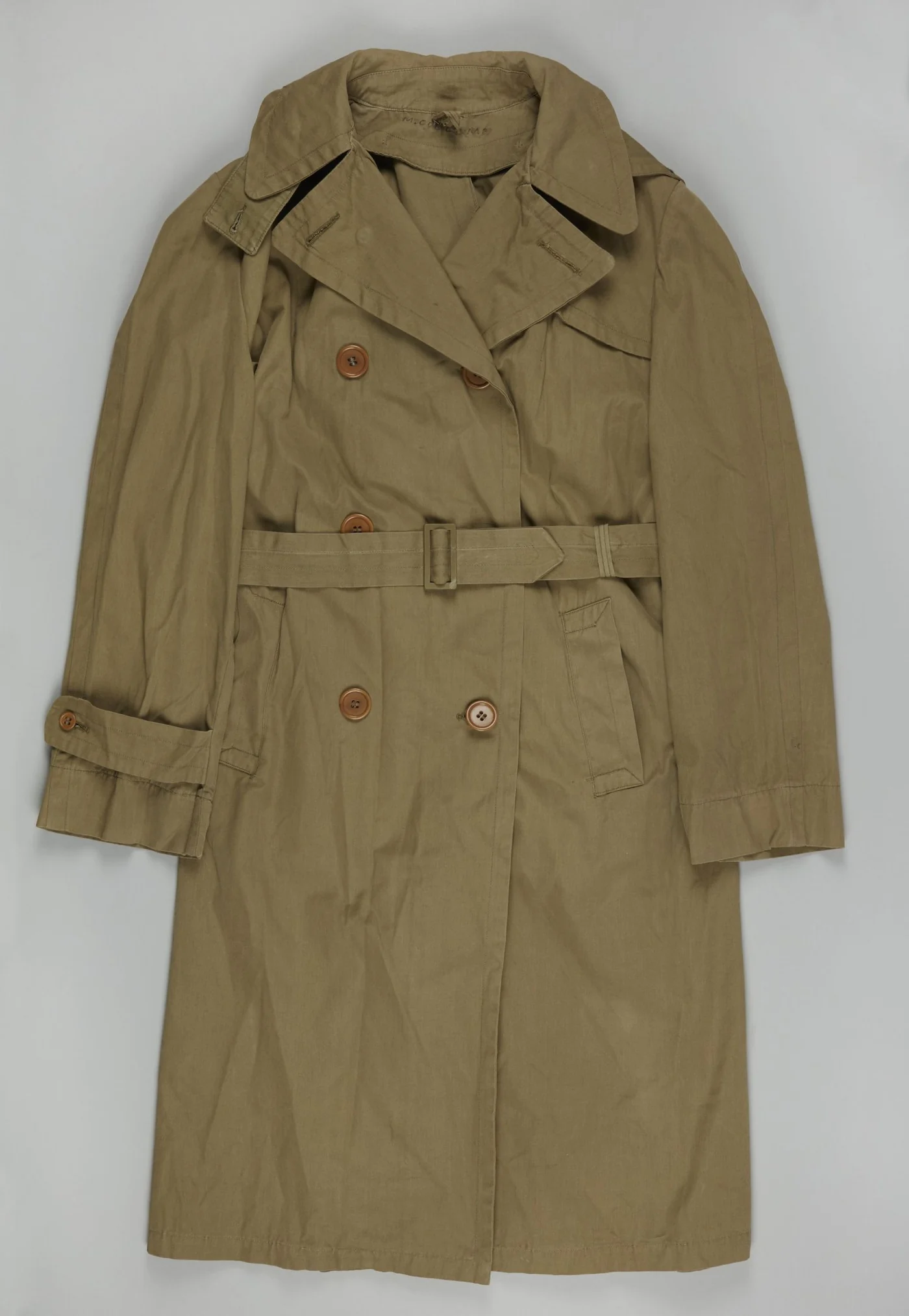
A trench coat carries a recognisable collection of details: overlapping fronts, a belt, shoulder tabs, flaps and a long line. Some developed in practical outerwear and military contexts; others have been retained, altered or exaggerated as the coat moved into everyday fashion.
History helps explain the vocabulary, but it does not certify the coat in front of you. A fashion trench may borrow the outline without the fabric, construction or documented weather protection you need. Read the inherited details and the current specification as two related questions.
Place the famous shape in a longer outerwear story
The V&A’s Burberry display guide connects the company’s gabardine development to protective outerwear and its adoption by officers during the First World War. Burberry’s own archive records the 1912 Tielocken patent as a predecessor to its trench. These are specific institutional and company accounts, not proof that one date explains every coat in the category.
The National Army Museum also describes the trench’s association with officers and its later civilian life. That context matters: the garment was not a uniform worn identically by every soldier. Broad statements about what everyone in the trenches wore flatten differences in rank, supply and other forms of military clothing.
Observe a detail before assigning its purpose
Burberry’s archive identifies epaulettes, D-rings, a storm shield and a gun flap among the functional details introduced for military use. When examining another coat, first name what is actually present. Shoulder tabs, a back yoke-like flap and rings on a belt are visible features; their exact original use should not be invented from resemblance.
A contemporary design may simplify the belt, omit the rings or move a flap for visual effect. Those changes need not make it a failed trench. They tell you that the designer is working with a vocabulary rather than reproducing one fixed object. Compare the actual coat with its stated reference instead of grading it against a vague idea of authenticity.
The belt changes the silhouette as well as the closure
Wearing the belt closed can gather the coat into a waist and make the lower half fan out. Leaving the coat open creates two longer front lines and reveals the clothes underneath. Tying or fastening the belt differently changes where fabric collects, but the available options depend on the coat’s actual belt, loops and closures.
Try it over the layers you intend to wear. A coat that closes neatly over a tee may behave differently over knitwear or a blazer. Inspect the shoulder, upper arm and overlapping fronts when seated and moving. The familiar trench label cannot substitute for those dimensions and the fit you need.
Civilian use gave the coat another set of meanings
The National Army Museum connects its postwar appeal with officers continuing to wear their coats and with cinema, including Casablanca. The V&A guide traces a move from practical and military dress to an enduring fashion form. These are documented routes through which the coat’s meaning changed, rather than a claim that one film alone created its popularity.
In an outfit now, a long trench can read as a broad outer frame. Underneath, jeans and a tee emphasise that it is part of daily clothing; a tailored base produces another relationship. Neither combination needs to impersonate an officer or a film character. Knowing the history can inform the choice without prescribing a costume.
Check weather protection in the present tense
If you need rain protection, read the exact model’s current fabric, finish, seam and care information. Water-resistant, water-repellent and waterproof should not be collapsed into one promise. A historical description of gabardine does not establish the performance of a modern coat made from a different material or construction.
For a practical example, imagine choosing between two visually similar beige coats for a wet commute. One supplies a documented protection claim and care guidance; the other supplies only a style description. The second may still be useful fashion outerwear, but the shared appearance does not fill the missing evidence for the journey you are planning.
Translate the shape into your own wardrobe
Build a board with the coat, your intended base outfit and actual shoes. Check where the coat hem sits against a skirt, dress or trouser hem and how much of the lower outfit remains visible. A long coat can make the outfit feel continuous; a shorter interpretation can expose more of the base silhouette.
If you already own a coat with the length and layer space you need, you may not need a trench to achieve that framing effect. If the trench itself is the point, choose the details you value and confirm them on the real garment. Heritage becomes useful when it sharpens the question, rather than answering every practical question in advance.
Put the idea to work
Your wardrobe. Your version.
Sources and scope.
- V&A — The Burberry Trench: Crafting an Icon, Display Guide
- Burberry — History
- Burberry — Our Story
- National Army Museum — Army Fashion Statements
What this article can establish
- History focuses on documented Burberry and British military examples. No waterproof rating or current product performance is inferred from the trench silhouette.