Give the cardigan a visible boundary
A cardigan looks deliberate when its neckline, front opening and hem help organise the clothes beneath it. Begin with a simple underlayer and trousers that sit securely, then choose how much of the front to close. A cardigan can be roomy without making the whole outfit vague if at least one of those boundaries remains clear.
Try it open before experimenting with buttons. Notice whether its front edges hang straight or roll inward, and where the hem sits against the trouser waist. Those characteristics come from the actual knit and construction. Styling can work with them, but cannot make a long, soft cardigan behave exactly like a short, firm jacket.
Match the neckline to what sits beneath it
A crew-neck tee provides a quiet centre beneath a V-neck cardigan. An Oxford adds a collar and a clearer upper boundary. A rugby shirt introduces both collar and pattern. Choose the underlayer according to how much activity you want near the face rather than adding several neck details automatically.
Check the back of the neck as well as the front. A shirt collar caught beneath the knit can make the cardigan stand away from the body. Settle the collar first, then let the cardigan rest naturally. If you add a necklace, judge its position against the opening; it may be unnecessary when the collar or knit texture already supplies enough detail.
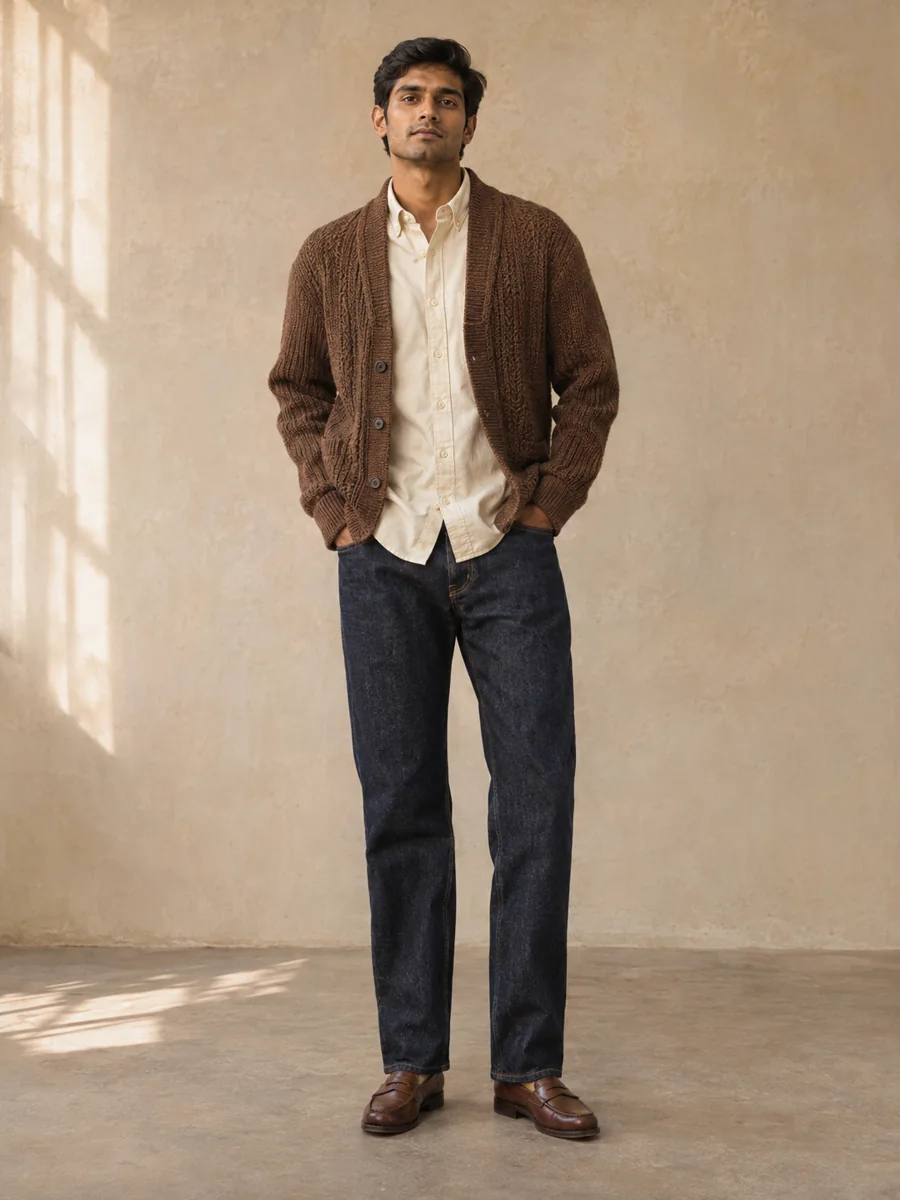
Brown cardigan, cream Oxford and dark jeans
A textured brown cardigan with a cream Oxford, dark jeans and loafers is an accessible starting point. The shirt gives the soft knit a defined inner frame. Dark denim keeps the lower half uncomplicated, and the loafers provide a clear finish without turning the outfit into formal tailoring.
Decide whether the shirt should be tucked by looking at its length. A long curved tail below a cardigan can interrupt the otherwise simple line. A relaxed tuck may solve that, but leave enough movement through the torso. Test the arrangement after sitting rather than smoothing it once and assuming it will remain in place all day.
Brown cardigan with a cream Oxford and dark jeans
Textured cardigan and wide denim
A textured cardigan above wide-leg jeans creates a looser, more expressive silhouette. Keep the underlayer quiet and watch where the cardigan finishes relative to the widest part of the denim. An open front can reveal the waistband and divide the upper body without requiring a close-fitting tee.
The cardigan and jeans can both be broad; the useful question is whether their edges remain visible. If the upper half seems to merge into the trousers, try changing the underlayer colour or shortening its exposed hem. That often provides more clarity than adding a belt with a large buckle or forcing every layer into a tuck.
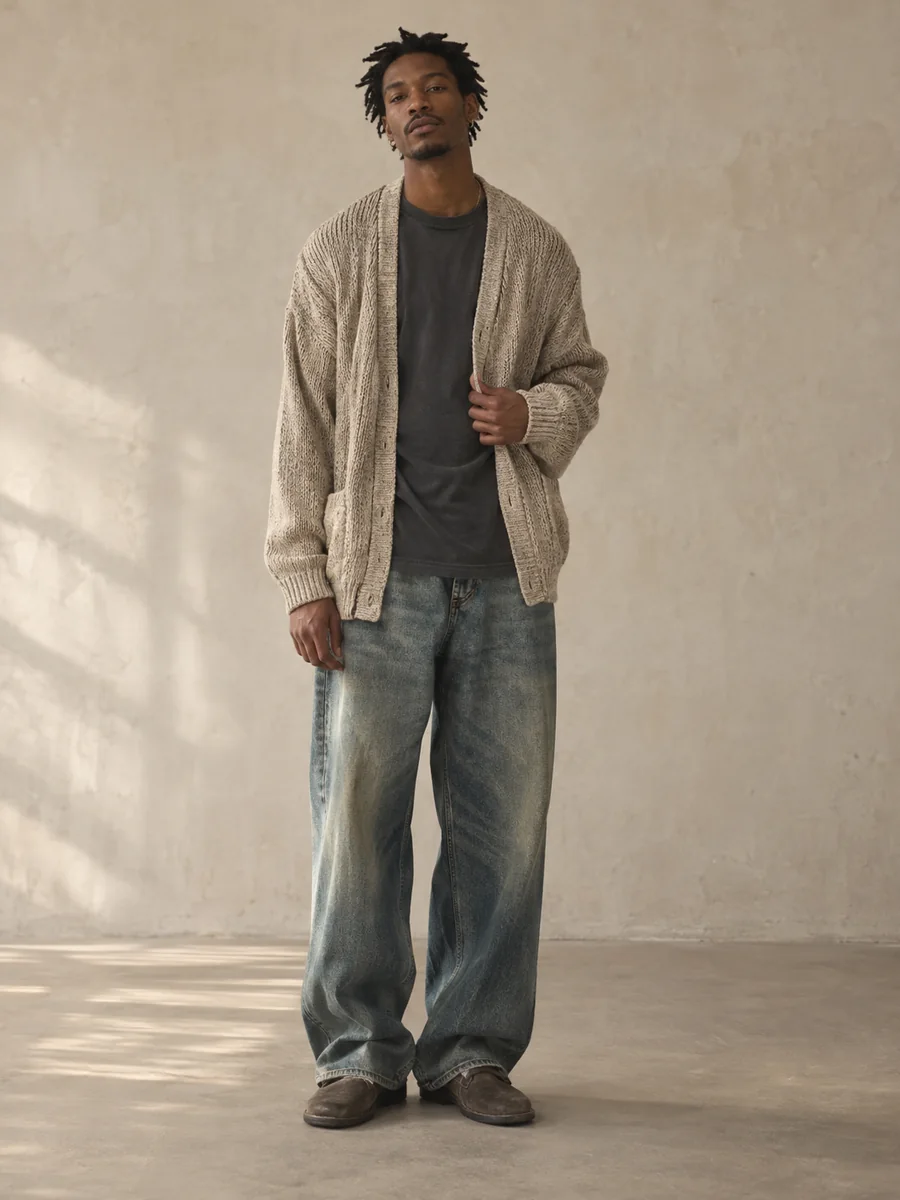
Textured cardigan, wide-leg denim
Control colour through a navy layer
A navy cardigan over a dusty pink Oxford, black pleated trousers and loafers uses the knit as a frame for colour. Closing part of the front reduces the visible pink; wearing it open increases it. This lets the same shirt feel quieter or more prominent without changing the entire outfit.
Use the button arrangement to support the shape rather than to follow a universal formula. Some cardigans hang better with a lower button open; others are designed to close cleanly throughout. Try the actual garment both ways. Stop if the placket pulls, gaps or forms an awkward ridge. Fit and knit construction matter more than repeating a styling instruction mechanically.
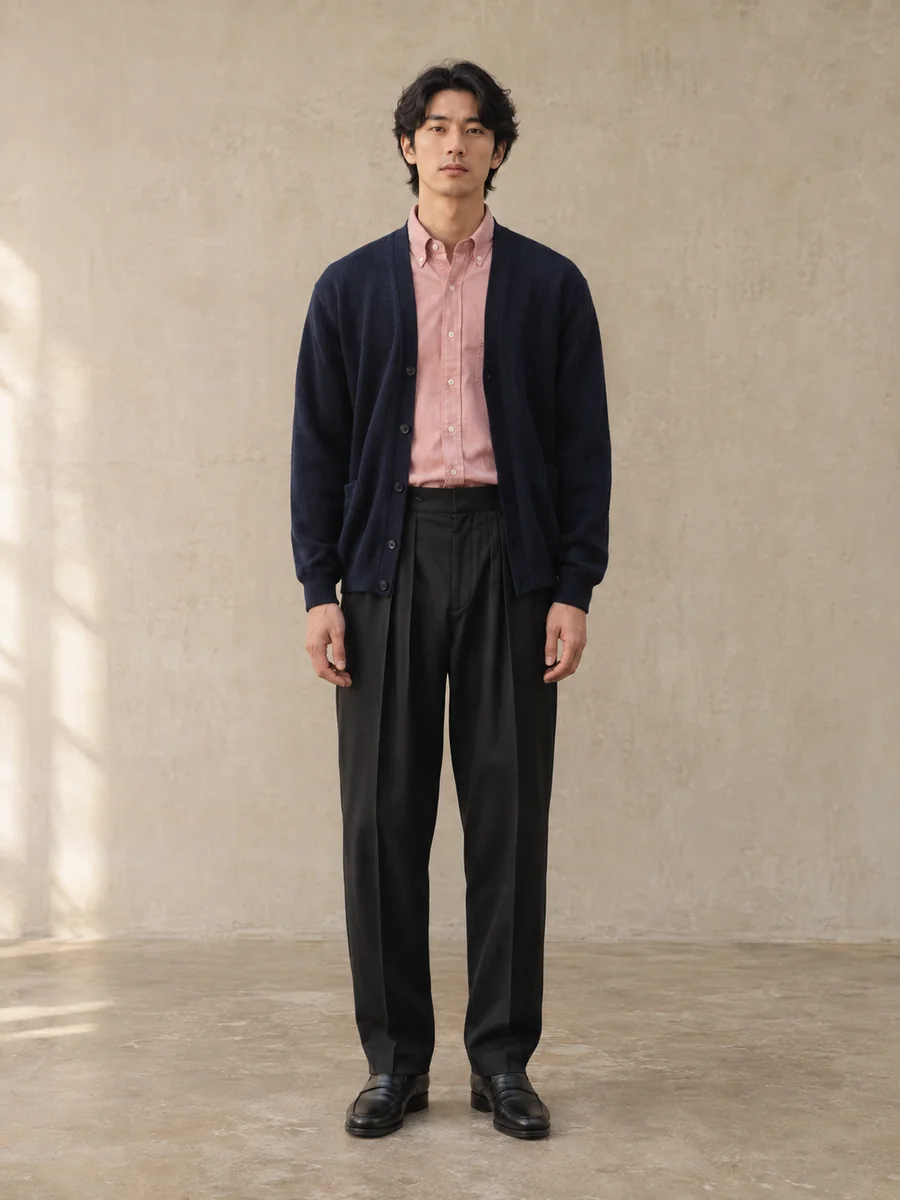
Dusty pink Oxford with a navy cardigan
Choose between patterned layers and darker texture
A charcoal cardigan over a restrained cream-and-navy rugby with brown cords creates interest through several textures. Keep the rugby stripes moderate so the collar and cardigan opening can still be read. Suede-looking shoes continue the softer surface of the trousers without adding another prominent pattern.
A black textured cardigan over a washed black tee and roomy black jeans takes another route. Here, the differences are mainly texture and length. Boots finish the lower half. These formulas ask different things of the cardigan: one contains a patterned underlayer, while the other helps distinguish similar dark surfaces. Pick the job before adding accessories.
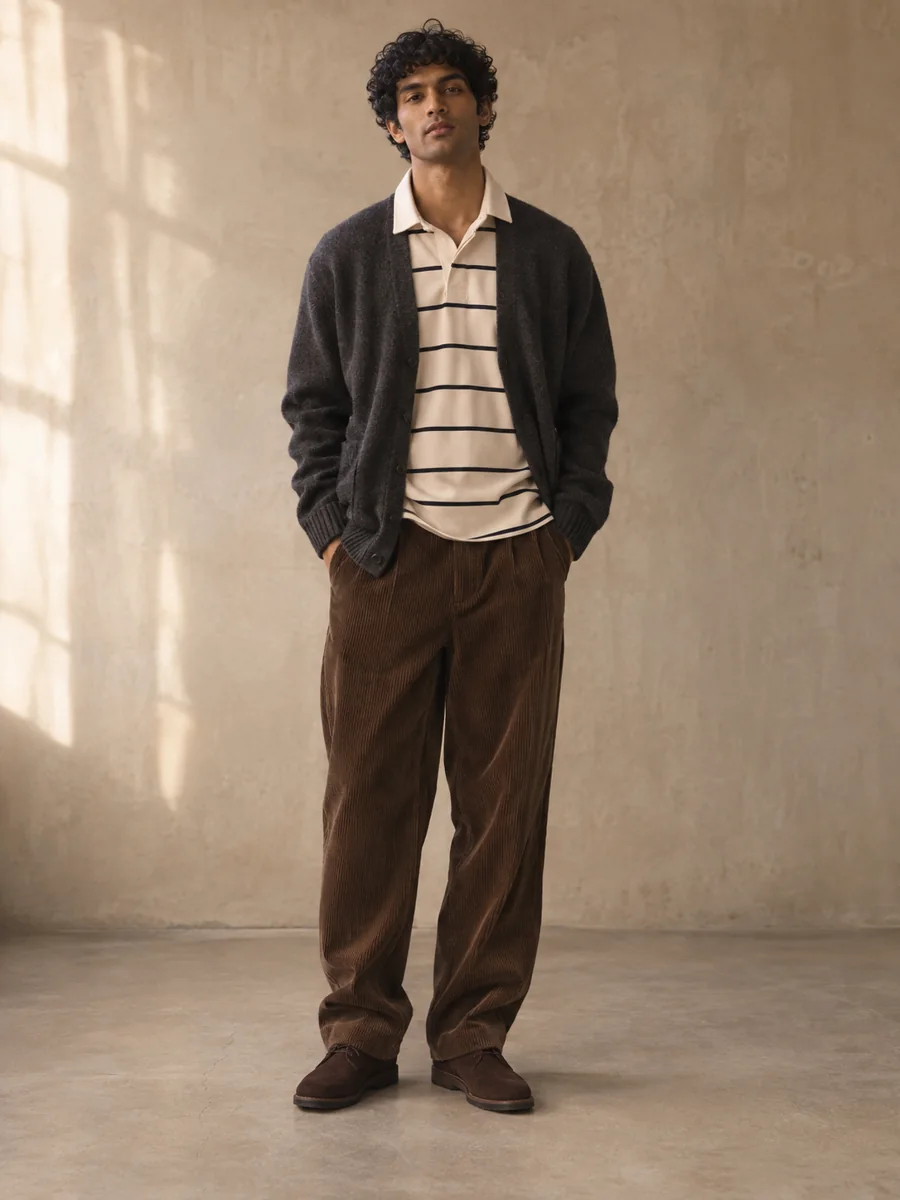
Charcoal cardigan with a rugby shirt and brown cords
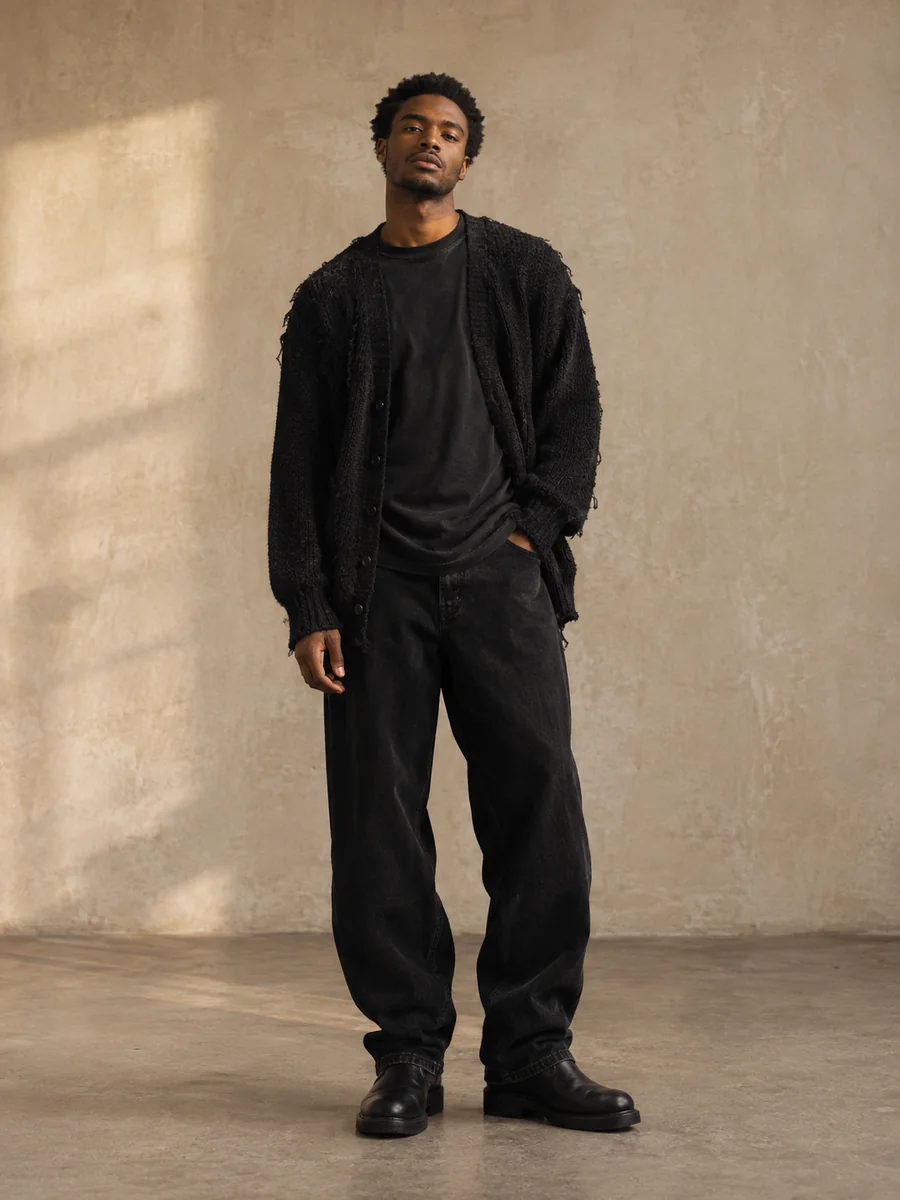
Textured black cardigan with loose black denim
Check movement, sleeves and care
Button the cardigan as you plan to wear it, then reach forward and sit down. If the front pulls sharply, try a different arrangement or underlayer. Do not rely on stretching the knit into a shape that feels uncomfortable. At the wrist, avoid trapping several thick cuffs inside each other; simplify one layer if necessary.
Follow the garment’s own care information and store it in a way suited to its construction. The word cardigan does not identify a fibre or a cleaning method. For the final styling check, look at the neck, waist and shoe together. If those three areas feel clear, the middle of the outfit can remain relaxed and textured.
Explore more outfit ideas or compare the style files.