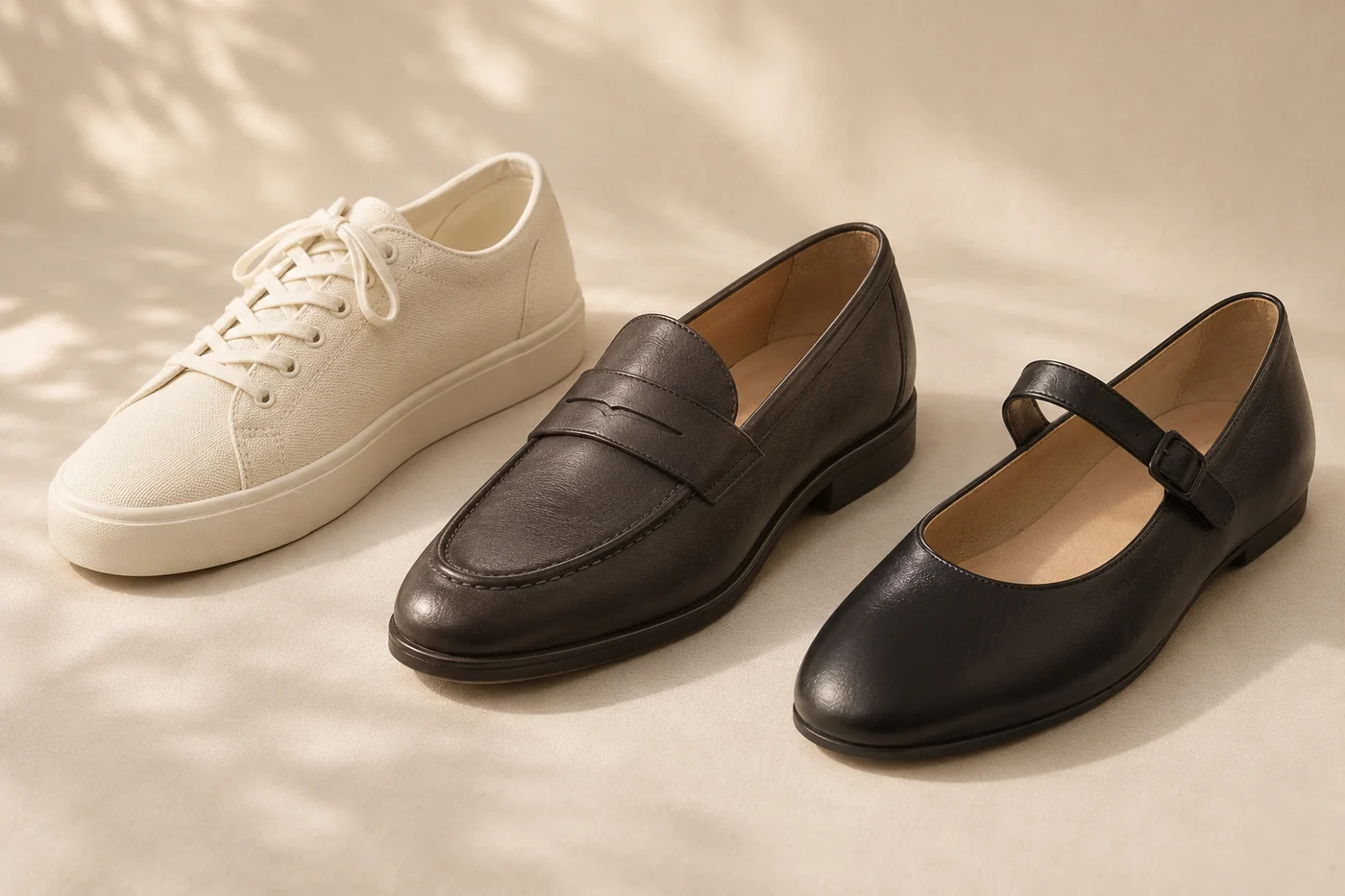
Changing from a sneaker to a flat shoe can reveal more of the foot, introduce a strap across it, or add the horizontal line of a loafer's vamp. Those differences often matter more to an outfit than the broad category name. “Flat” also covers different heel heights, sole shapes and degrees of coverage.
This guide uses three official references checked November 7, 2026: Repetto's black Cendrillon, Rothy's black Square Mary Jane and G.H.BASS's guide to classic and lug Weejuns. They establish examples of construction and shape, not a ranking of what people currently wear.
Ballet flat: start with how much foot is visible
Repetto's checked Cendrillon page specifies black nappa calfskin, a one-centimetre heel, cotton lining and a leather sole. It describes a cutaway shape and stitch-and-turn construction. Those details belong to that reference; other Cendrillon versions and other ballet flats can differ.
For styling, concentrate on the opening. A lower opening leaves a different area visible from a shoe with a higher vamp. With trousers, the space between opening and hem can become an intentional pause. With a longer skirt, the visible toe and heel may carry most of the shoe's visual effect.
Try a straight trouser at its normal length before adding a crop. If you want a more continuous line, use a sock or hosiery colour related to the lower garment. If you want the shoe to be distinct, let the edge of the opening remain visible. These are options to compare, not requirements attached to a particular body.
Mary Jane: the strap becomes part of the composition
Rothy's Square Mary Jane in black uses a rounded-square toe and a slim flexible strap, according to its product page. The strap makes a separate line across the foot; the toe introduces another shape at the bottom of the outfit. A Mary Jane can therefore look quite different from an unstrapped flat even when both are black.
With a midi skirt, compare a plain sock, bare ankle where appropriate, and opaque hosiery. Each changes how clearly the strap appears. A dark strap against a light sock is more conspicuous than the same strap against a similar dark tone.
With full-length trousers, check whether the strap is visible at all. If the hem covers it, the practical question may become toe shape and sole rather than the shoe's category. You do not need to expose every design detail to make a coherent outfit.
Loafer: compare classic and lug versions
G.H.BASS distinguishes a classic Weejun with a leather outsole from lug interpretations with an EVA lug outsole. Its guide also identifies moccasin construction, the gathered beefroll detail and the penny keeper. These give a loafer more visible structure across the upper than an open ballet flat.
That does not make every loafer heavy. The edge of the outsole, the height of the vamp and the toe outline can produce a compact or substantial effect. Compare the exact model rather than using “loafer” as shorthand for one level of formality.
Under a wider trouser, a thicker sole can provide a clearer lower edge; a classic sole can keep the finish quieter. Under a shorter trouser, the exposed sock becomes a larger part of the composition. Try the same base with two sock colours before deciding that the shoe itself is the problem.
Flat is a styling description, not a fit promise
A low heel does not establish adequate room at the toe, secure hold at the heel or suitability for a long day. A strap can alter retention, but its placement and adjustment still need to work for the wearer. Product-page comfort language remains a manufacturer's claim until you assess the actual fit.
Use the relevant brand's sizing instructions and return terms. A size that works in a sneaker does not automatically transfer to a leather slip-on or knitted Mary Jane. Walk indoors on a suitable surface and notice pressure, heel movement and where the shoe bends, within the retailer's conditions for a return.
Read care and surface suitability for the exact pair as well. A leather sole and a rubber sole are different specifications. Neither a photograph nor a style name proves wet-weather grip or water resistance.
Give each shape the same fair trial
Choose one everyday base, such as a plain shirt and straight trousers. Test the three roles: a more open flat, a strapped flat and a higher-vamp slip-on. You can use shoes already owned or compare references before shopping; there is no need to acquire all three.
Record what changed in the outfit, then what changed in practical use. You may like the openness of a ballet flat with one skirt, the strap detail of a Mary Jane with another, and a loafer under trousers. That is a useful wardrobe map, even if none of the categories becomes your default.
Current product pages help you find examples. They do not measure street adoption or tell you which shape deserves a purchase. Let repeatable combinations and comfortable fit make that decision.
Put the idea to work
Your wardrobe. Your version.
Sources and scope.
- Repetto: Cendrillon in black nappa calfskin
- Rothy's: The Square Mary Jane in Black
- G.H.BASS: loafer guide
What this article can establish
- Small official-source shape sample, not a measured footwear trend. No personal fit, comfort or weather-performance testing.