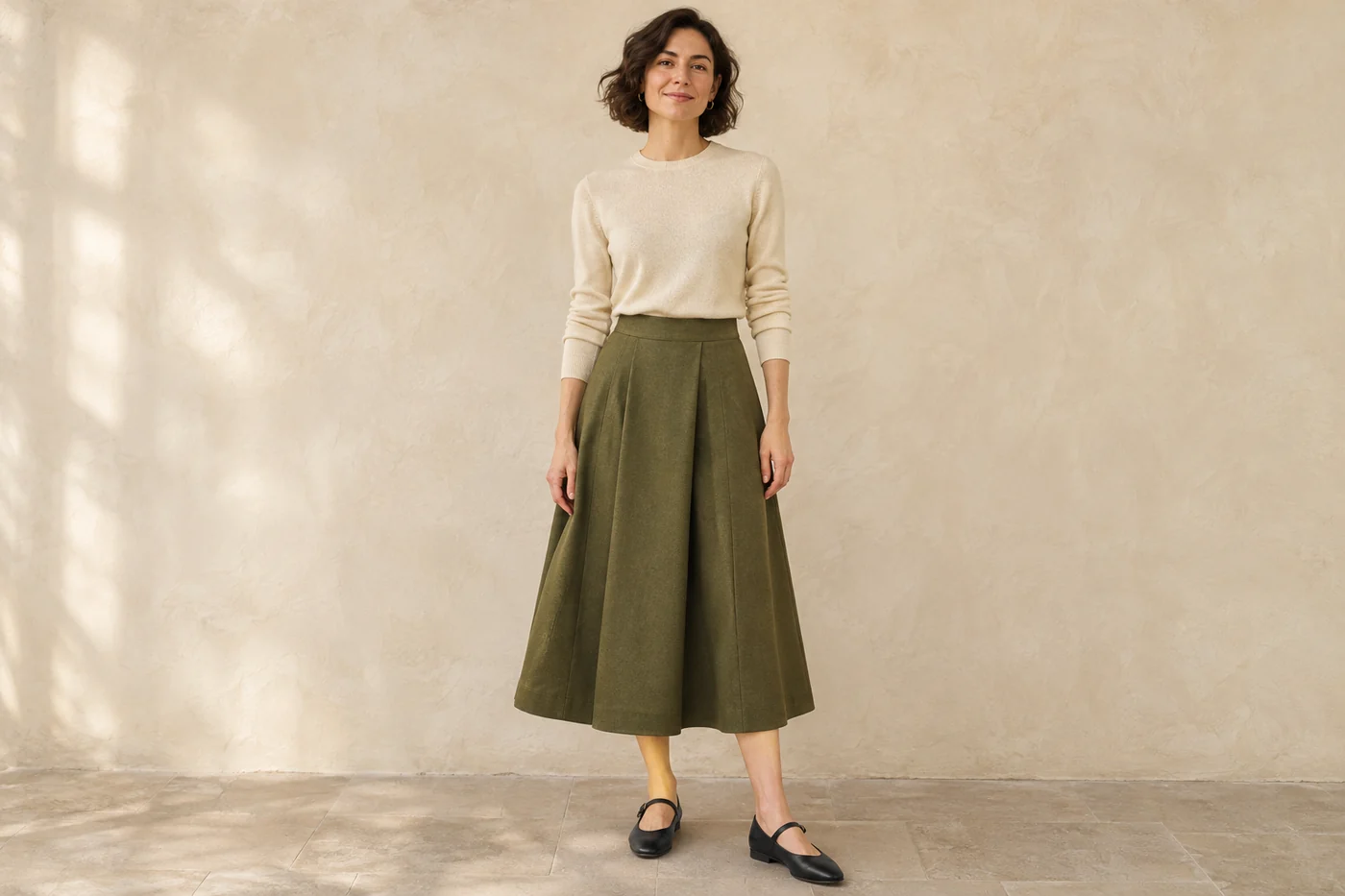
The useful question is not whether one shoe category goes with every midi skirt. It is how much of the shoe you want to see beneath this skirt, and whether the pair makes sense for your day. A narrow straight skirt, a pleated A-line and a softly draped midi create different spaces around the foot.
Start with the skirt you own, wear it at its usual waist position and compare two shoes before changing the top. You will learn more from that controlled swap than from a list of supposed universal matches.
Read the hem before the heel height
Midi is a broad length description. On different people, the same skirt can end at different points between knee and ankle. Notice the actual distance between its hem and your shoe, then look at the width of that space. A straighter skirt makes a narrow frame; a full one makes a moving outer line.
Heel height is only one part of the shoe. Toe length, sole thickness, shaft height and straps also affect what you see. A pointed flat can have a longer visual line than a round-toe heel. That observation does not make either more flattering or more appropriate; the outfit and your comfort decide.
Straight skirt with a low loafer
Try a charcoal straight midi, cream fine knit and black loafers. Tuck a small amount of the knit if you want the waistband to appear, or choose a hem that ends near it. The skirt supplies a long quiet panel, and the loafers make a compact endpoint. A black shoulder bag can repeat the shoe without adding another strong color.
Compare dark fine socks with bare ankles or tights according to what you like and need. A contrasting sock makes a distinct band above the foot; a dark sock continues more of the shoe's color. If the skirt has a slit, check it seated and while walking. A good still photograph cannot establish practical coverage.
Full skirt with a strapped flat
Try a navy A-line midi, a short striped tee and dark Mary Janes. The shorter top leaves the skirt's fullness visible from the waistband. The strap gives the foot a small clear detail beneath a larger moving shape. Keep any jacket simple while deciding whether the skirt or stripes should lead.
Mary Jane designs vary in sole, toe and strap arrangement. Dr. Martens' 8065, for example, uses two adjustable buckle straps and decorative broguing. That particular design reads differently from a thin-soled single-strap flat. Use the actual pair's outline when making the comparison, rather than assuming the category name produces one effect.
Draped midi with a visible boot shaft
A fluid-looking dark midi, close-fitting long-sleeved top and ankle boots can form a continuous lower line, especially when the boot rises beneath the skirt. You do not need to preserve a band of bare leg. Compare this with a shorter boot that leaves a gap; the separate spaces create a different rhythm.
Move before choosing. A full skirt may brush the shaft or catch on a protruding detail, while a narrow skirt may restrict your stride for reasons unrelated to the shoe. Do not infer warmth, waterproofing or slip resistance from a boot's appearance. Check the maker's specifications when those properties matter for the day.
Pleated skirt with a sneaker
Try a cream pleated midi, gray sweatshirt and low navy sneakers for a casual combination. Let the sweatshirt finish around the high hip, or compare a loose front tuck if the fabric allows it comfortably. The sporting top and sneaker create a different language around the skirt without requiring a matching set.
A fuller runner can work too, but it adds more shape at the bottom. Keep the same skirt and sweatshirt while trying it. If the foot feels visually crowded, inspect sock height and the skirt-to-shoe gap before changing the entire outfit. The sneaker does not automatically make the skirt suitable for every dress code or walking distance.
Use the top to clarify the version you want
The same skirt and shoes can look quite different beneath a short cardigan, an open shirt or a long blazer. A short top exposes more of the skirt's shape. An open shirt creates a center panel. A blazer adds a firmer shoulder and longer frame. Choose the layer because it supports the direction you want.
For example, keep a black midi and black loafers, then compare a white tee with an oversized denim shirt worn open. The second version adds a longer relaxed frame and more upper volume. If you prefer it, you have found a useful relationship; you do not need a rule that midi skirts must always have small tops.
Save the pair you can move in
Photograph your preferred combination from front and side, then sit, walk and use a step if that reflects your day. Check the back hem, secure footing and whether a strap or boot edge catches the skirt. Styling cannot fix a shoe that slips at the heel or causes discomfort.
Save the actual skirt, top and shoes as a board, with a note about socks and any planned layer. Keep a second option for a different setting. These are complete alternatives when their roles change meaningfully, not new outfits created merely by swapping one nearly identical accessory.
Put the idea to work
Your wardrobe. Your version.
Sources and scope.
What this article can establish
- Outfit formulas are editorial proposals, not photographs of exact purchasable sets or results from a wear test.