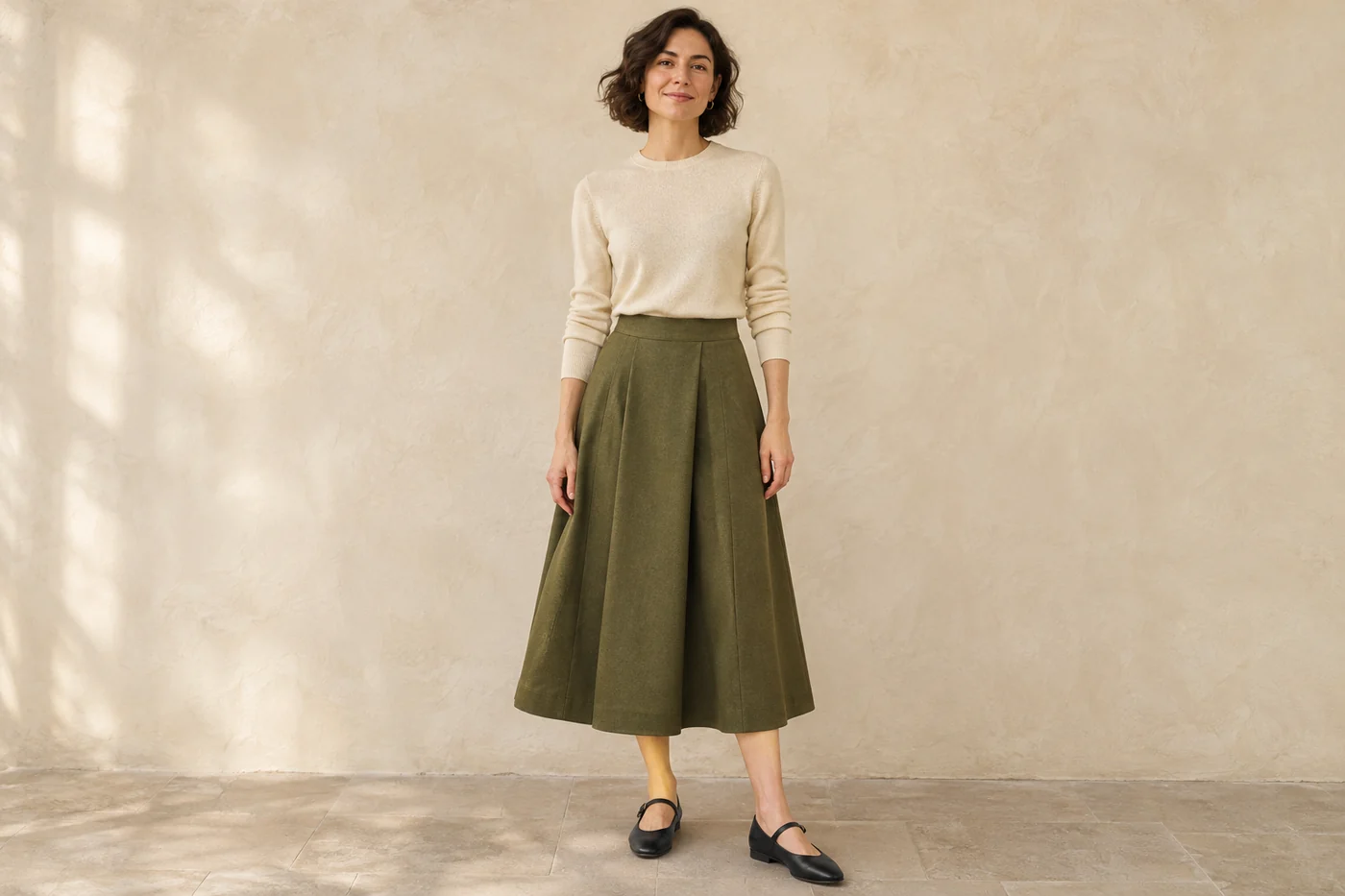
A Mary Jane's strap creates a visible detail across the foot, but it does not decide the entire outfit. A low single-strap flat, a rounded double-strap shoe and a platform version can produce very different lower outlines. Look at your actual pair before choosing what should sit above it.
These three formulas use trousers, a skirt and a dress so you can give the shoe different roles. None depends on a gender rule or a costume-like set of matching references. Start with the clothes and the setting you already have.
Read the actual shoe, not a style stereotype
Notice the toe length, opening around the foot, strap placement and sole thickness. Dr. Martens' 8065 is one documented Mary Jane with two adjustable buckle straps and decorative broguing. Those details make a busier upper than a plain single-strap flat. They do not establish how either shoe will fit you or how long you can comfortably wear it.
Buckle the shoe securely within its intended adjustment, then walk normally before styling around it. A strap does not guarantee a secure heel or enough room over the foot. Use the maker's own size information and the fit of the specific pair. Avoid assuming that all Mary Janes need the same size as another shoe category.
Formula one: straight trousers and a visible strap
Try charcoal straight trousers, a white tee and an open dark cardigan with black Mary Janes. Set the trouser hem so it reveals the amount of upper you want without catching awkwardly on the strap. The trousers and cardigan supply a quiet frame, leaving the shoe detail readable.
Use a dark sock first, then compare cream if you want a stronger boundary around the shoe. The cream version repeats the tee at a smaller scale; it need not be an exact white match. If the contrast feels too pronounced, return to a tonal sock rather than adding more white accessories to justify it.
Wide trousers give the shoe a different job
With full-length wide trousers, much of the strap may disappear. That is acceptable if you like the toe and sole as a compact endpoint. Try navy wide trousers, a gray short-sleeved knit and dark strapped flats. Keep the top hem deliberate so the outfit's broad lower shape remains clear.
If seeing the strap is the reason you chose the shoe, compare a shorter hem or another trouser you already own. Do not keep lifting the waistband to expose it in a photograph. A fuller-soled pair may remain more visible, but buying one is not the only answer to a hem relationship you can change.
Formula two: a midi skirt with a quieter top
Try a dark A-line midi, a compact blue shirt and black Mary Janes. The skirt supplies movement and width; the shirt's collar gives the upper half a defined boundary. A loose tuck can make the skirt's beginning visible. Leave the shirt untucked if you prefer the longer upper panel and it does not crowd the skirt shape.
Compare a fine dark sock with tights or your preferred uncovered ankle. They change the amount of separate space between skirt and shoe. The desired gap is a matter of styling preference and practical coverage, not a requirement to make the leg look a particular way. Check the skirt while seated as well as standing.
Formula three: a dress and one useful outer layer
Try a plain navy shirt dress with burgundy Mary Janes and a gray cardigan. Here the dress remains the main shape, while the shoe adds a contained color difference. You do not need a burgundy bag and scarf. Repeating the color once can be a choice, but the shoe can also stand alone.
For a more structured version, replace the cardigan with a short dark jacket. The jacket changes the upper outline while the dress and shoe remain stable. Compare that swap before changing accessories. It produces a meaningful alternative because the outer frame changes, rather than presenting a near-identical outfit as a wholly new formula.
Let socks change the balance deliberately
A thick ribbed sock occupies more visible space than a fine sock, especially above a low-cut shoe. With a skirt, it can become a main detail. With trousers, only a narrow strip may appear. Evaluate that visible result instead of choosing a sock in isolation from the hem.
Avoid layering socks simply to copy a photograph if the extra thickness makes the shoe tight. A different sock color can create contrast without adding bulk. Check the fastening after the change, and do not rely on the strap to force an uncomfortable fit. Any comfort conclusion belongs to trying the actual combination, not its visual category.
Keep the pair connected to your ordinary wardrobe
Save one trouser board, one skirt board and one dress board only if the clothes actually exist in your wardrobe. If you do not wear skirts or dresses, make a second trouser formula with a genuinely different shape or layer. The article offers options, not an inventory you must acquire.
Write down the hem and sock arrangement you prefer. If a particular strap stays hidden, decide whether that matters before shopping for another bottom. The useful result is a repeatable combination that reflects your own style and activity, with a shoe that works as footwear as well as a visual detail.
Put the idea to work
Your wardrobe. Your version.
Sources and scope.
What this article can establish
- Outfit formulas are editorial proposals, not photographs of exact purchasable sets or results from a wear test.