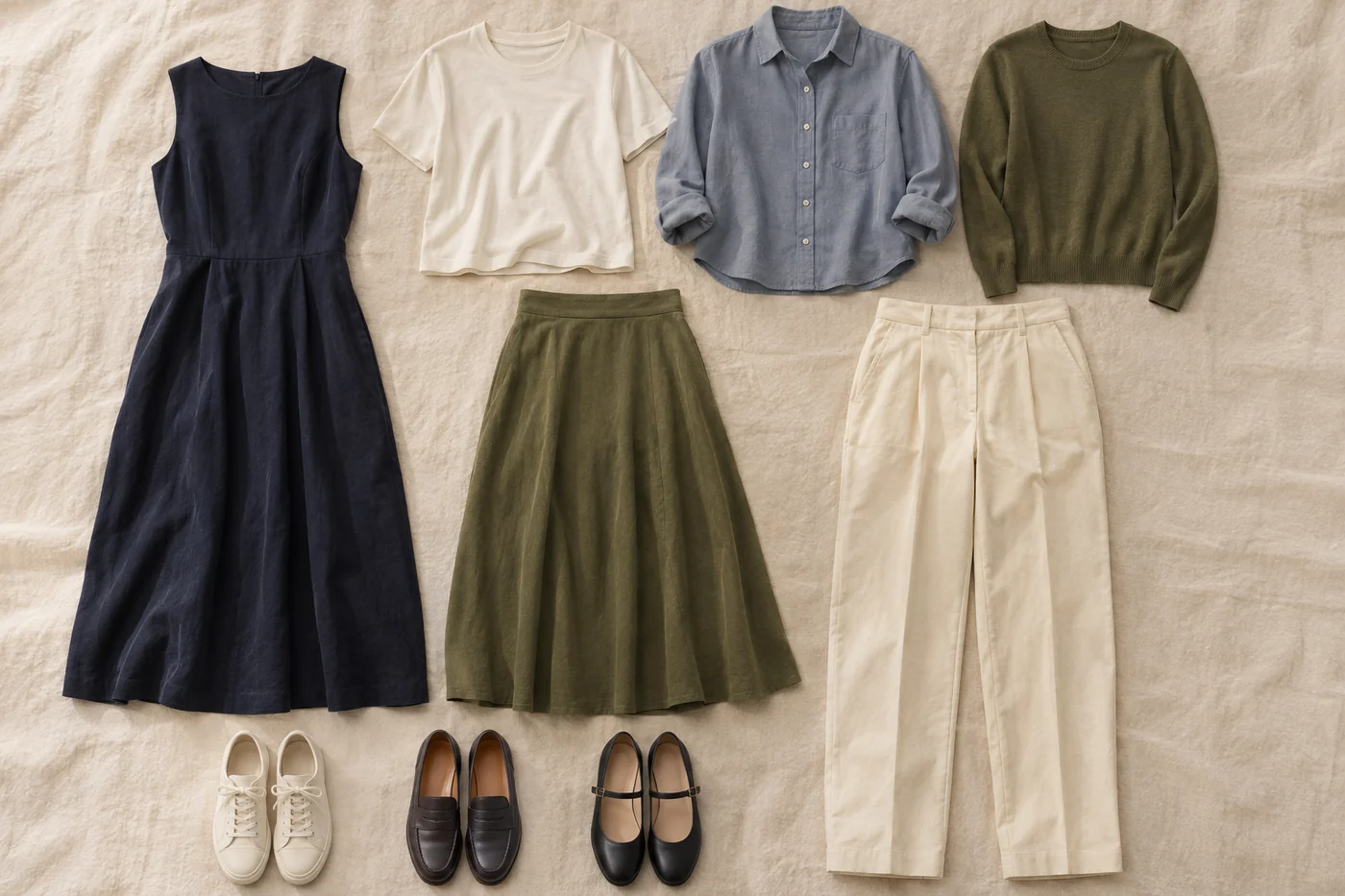
A casual-office capsule needs a clear working assumption about the office. Start by checking the policy and the occasions you actually attend. A creative studio, public-facing role and client meeting may have different expectations even within the same week.
This example assumes a workplace that allows simple tees, clean sneakers, skirts and dresses on ordinary days, with a jacket and more formal shoes for some meetings. If your workplace requires a collar, uniform, protective clothing or a particular shoe, change that constraint first. A capsule should organise the clothes the setting permits.
Choose ten pieces with distinct jobs
The sample inventory is a cream shirt, a navy tee, a fine gray knit, charcoal trousers, a navy midi skirt, a dark day dress, a soft blazer, everyday sneakers, plain loafers and a journey coat. These are ten main pieces, excluding underwear, socks and other personal requirements. Use pieces you own wherever they already do the job.
The trousers and skirt supply different lower outlines; the dress provides a complete one-piece alternative. The blazer adds a visible frame to several bases. The coat serves the journey and must be chosen for actual conditions. Neither a tailored appearance nor a dark color proves workplace approval or weather protection.
Keep three ordinary-day bases
First, try the navy tee with charcoal trousers and sneakers. Second, combine the cream shirt with the navy skirt and loafers. Third, use the day dress with the gray knit as an intentional layer if their necklines and sleeves fit together. If the knit makes the dress bunch, keep the dress as its own base instead.
Test each base after removing the coat and blazer. You may spend most of the day in that simpler version. Check sitting at a desk, reaching shelves and walking your normal route. Your preferred amount of room is more useful than an office outfit photograph that only looks tidy while standing still.
Make meeting versions by changing the required role
For a jacket-required meeting, add the blazer to the cream shirt and charcoal trousers, then use loafers if permitted. For another version, try the blazer over the day dress with the same shoes. The purpose is to meet a specific requirement while reusing the base, not to claim every blazer automatically makes every garment formal.
If a collar is required, replace the tee with the cream shirt. If sneakers are not allowed, use appropriate footwear you already know you can wear through the day. Some requirements will need a different capsule altogether. Keep those occasions visible instead of quietly counting an unsuitable everyday outfit as a solution.
Create a realistic five-day rotation
Plan Monday around the tee and trousers, Tuesday around the shirt and skirt, Wednesday around the dress, Thursday around the shirt, trousers and blazer, and Friday around the knit and skirt. The fourth and fifth days reuse garments deliberately, so review laundry access and your own comfort with repetition.
A fixed day order is optional. Save the rotation by activity when your schedule changes often: desk day, presentation, walking commute, remote call or evening event. Each saved version should name the complete combination and the reason it fits that setting. A broad business-casual tag cannot record all those distinctions.
Check the two layers as a pair
Wear the journey coat over the blazer as well as over the simpler bases. Sleeve and shoulder room may differ. Check how the blazer hem behaves inside the coat and where you will put a removed layer. A bag that carries a laptop may not also have room for a folded knit.
Use the clothing’s own care instructions when planning repeated use. A skirt, shirt and jacket can require different treatment even in the same palette. If a piece is unavailable for cleaning or repair, remove it from that week’s choices and inspect the remaining complete outfits.
Save the capsule as a set of decisions
Add the actual pieces to the wardrobe and save the successful combinations in the outfit builder. Put them in the planner with a short note about the dress-code assumption. Planning a future outfit remains separate from recording a confirmed wear.
When you discover a gap, name it narrowly. Perhaps the issue is a permitted shoe for a long commute, rather than more office clothes. Perhaps you need a second washable shirt because the first one cannot return to the rotation in time. A precise limitation gives you a better next step than expanding the capsule without a demonstrated use.
Put the idea to work