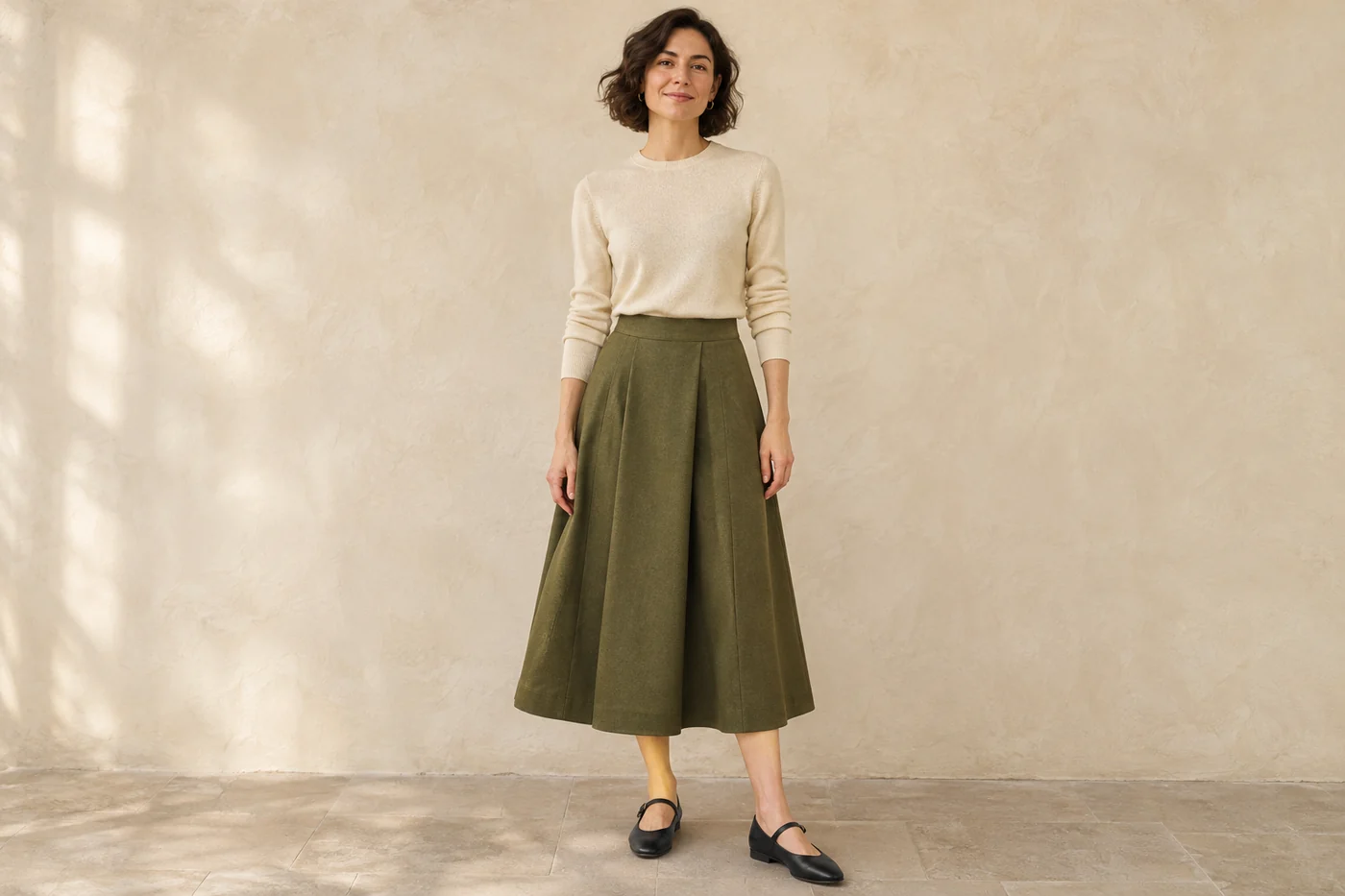
A skirt-led capsule becomes useful when the tops work with the actual waistbands, lengths and movement of your skirts. Start with two skirts and three tops you own, then test the combinations rather than counting every mathematical possibility as an outfit.
For this example, use a dark straight midi skirt, a fuller patterned skirt, a close-cut cream tee, a roomy blue shirt and a short dark cardigan. Add sneakers, loafers and one everyday bag. That is eight main pieces. The sample is a way to organise decisions, not a required capsule size or a promise that those shapes suit every preference.
Make the skirts different in a useful way
The straight midi creates a relatively narrow lower outline. The fuller skirt carries more visible fabric and pattern. Those differences let the same top play different roles without requiring a completely new wardrobe. Your contrast could instead be a short skirt and a longer one, a structured skirt and a softer one, or two skirts used for different activities.
Try each skirt with the shoes before selecting the tops. Sit down, take a normal stride and use any steps you regularly encounter. Check fastenings and pockets with your actual bag. A slit or elastic waistband visible in a photograph does not establish how a particular garment will move on you.
Assign each top a clear role
The cream tee provides a quiet upper shape and can show more of a waistband if you choose to tuck it. The blue shirt offers an open collar, sleeves you can arrange and the possibility of a longer outline. The short cardigan can be worn as a main top if its coverage and fastening suit you.
Try the roles without enforcing a fitted-top rule. A roomy shirt can work with a full skirt when you enjoy that volume. A closer top can work with a straight skirt when you prefer a continuous outline. The relevant question is whether the specific lengths and openings feel intentional and comfortable to you.
Write a six-cell matrix before adding extra layers
Create one row for each skirt and one column for each top. Each cell needs an actual shoe and a note about how you intend to wear the top. Use the list below as six drafts, then replace any failed cell with a blank. A blank records what you learned; it is not automatically a shopping gap.
- Dark midi + cream tee + sneakers; test a full tuck and an untucked version.
- Dark midi + blue shirt + loafers; check the shirt hem against the skirt length.
- Dark midi + cardigan as top + loafers; inspect button spacing while seated.
- Full patterned skirt + cream tee + sneakers; leave the pattern as the main detail.
- Full patterned skirt + blue shirt + sneakers; test an open neckline and a loose tuck.
- Full patterned skirt + cardigan as top + loafers; compare the two hem boundaries.
Resolve the waistband and top hem together
A tucked shirt may feel bulky at one waistband and comfortable at another. An untucked tee may cover the detail you wanted to show. Take those as specific garment interactions. Try changing the top arrangement before deciding that an entire skirt shape cannot work for you.
If you use a partial tuck, check it after sitting and walking. If you prefer an untucked top, examine the side view and how the hem meets the widest visible part of the skirt. There is no need to expose a waist or lengthen the appearance of a leg unless that is an effect you personally want.
Turn successful cells into saved outfits
Record the real skirts, tops and shoes in the wardrobe, then make one outfit board for each successful cell. The outfit builder supports a separate top-and-skirt combination. Save each version with a descriptive name such as blue shirt, dark midi, loafers, so it is distinguishable later.
The capsule builder is useful for inspecting its listed catalogue combinations, but your private matrix should reflect the outfits you have actually assembled. Six tested cells are a stronger starting point than an inflated total that assumes every layer and shoe can be swapped without review.
Repeat the tops at the pace your routine allows
Plan the cells across the days you need them and consider laundering and drying time. A cardigan used as a main top may need a different rotation from the same cardigan worn over a tee. Follow the care label for each garment; the capsule cannot set one washing method for the whole selection.
After a week, keep the useful cells and add a note to the uncertain ones. You might find that the blue shirt needs a shorter sleeve arrangement with one skirt, or that a single pair of shoes handles most days. Revise that relationship first. A capsule earns its place through repeatable use, not through a perfectly filled grid.
Put the idea to work