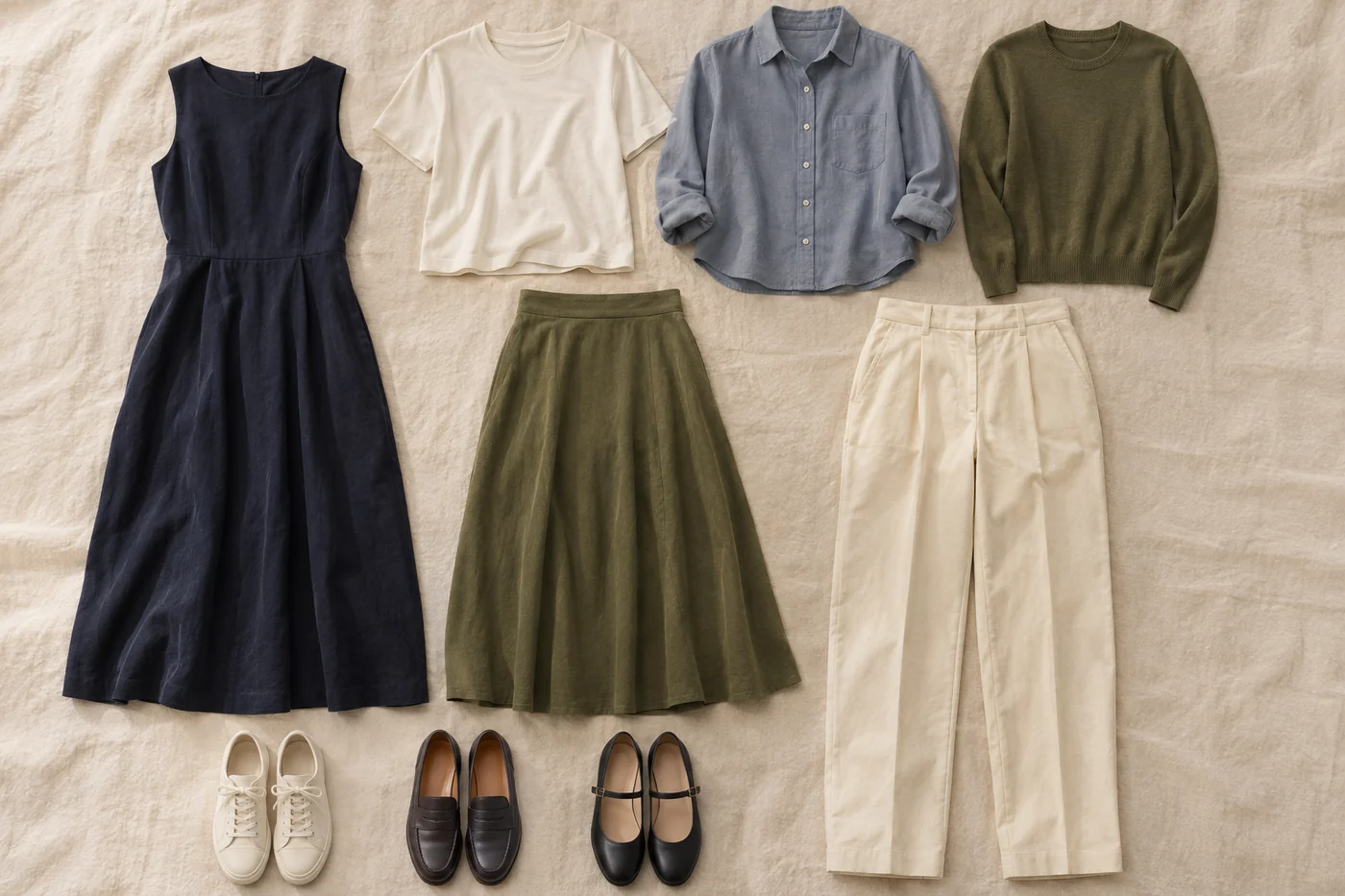
A dress-led capsule starts with the days you need to dress for and two dresses you already enjoy wearing. Add layers and footwear that work with both, then record complete combinations. A useful small selection is one you can wear repeatedly; its success does not depend on every item pairing with every other item.
The example below uses seven main pieces: a navy shirt dress, a dark jersey column dress, a cream cardigan, an olive overshirt, everyday sneakers, loafers and one bag. Treat these as wardrobe roles rather than a shopping list. Your preferred lengths, fastenings and shoe shapes can change the selection without changing the method.
Give the two dresses different jobs
Choose a first dress that already handles your busiest everyday activity. A shirt dress might provide an adjustable opening and a clear collar; a pull-on dress might be simpler to get into. Check sitting, reaching and the bag you carry. A dress that requires constant rearrangement is a weak foundation for your particular routine, even if you like its photograph.
The second dress should offer a difference you want to use: another sleeve arrangement, a straighter line, a fuller skirt or a different level of formality. Two nearly identical dresses can be useful, but do not assume they create different outfit options merely because their colors differ.
Build the first three combinations around one dress
With the navy shirt dress, start with sneakers and the bag for an ordinary errands day. Add the cream cardigan for a version with a softer frame around the collar. For a third combination, use the olive overshirt and loafers, leaving enough dress visible below the outer hem to keep the main silhouette readable.
These are three proposed combinations, not three verified product outfits. Try each with your own pieces. If the overshirt catches on the skirt or the collar competes with the dress collar, remove that pairing from the capsule instead of counting it as a theoretical option.
Let the second dress change the outline
The dark column dress supplies a more continuous vertical shape. Wear it with loafers and the bag for the simplest version. Add the cardigan with sneakers for a softer everyday combination. Finally, try the open olive overshirt and sneakers, using the two open edges to frame the dress.
You now have six specific drafts to inspect. A dress supplies the main one-piece role: it does not need a separate top and trousers to make the outfit complete. An intentional underlayer remains optional and needs its own comfort check at the sleeves, neckline and waist.
Check every layer in the position you will use
Button, zip or leave the outer layer open exactly as planned. A cardigan that works open may pull when fastened over the dress. A loose overshirt may bunch under the strap of your actual bag. Check these combinations while moving, rather than solving their appearance only in a still pose.
Choose coverage for your needs and the forecast. The names jersey, cardigan and overshirt do not establish a temperature range or rain protection. Hosiery, socks, underwear and any assistive or modesty layers belong in your real plan even when they are absent from a simplified outfit board.
Save a small set of complete boards
Add the clothes you actually own to the wardrobe, using names that distinguish the two dresses. In the outfit builder, make the six drafts separately and save only the versions you would consider wearing. Keep the dress in the main one-piece role and add layers deliberately.
Put the saved versions into the planner by activity. If a catalogue concept helps you begin, replace its pieces with your own before treating it as an owned outfit. A missing cardigan is still missing; a similar color in a reference image does not establish ownership.
Use the week to find the real limit
Leave room for laundering, drying time and personal comfort with repeating clothes. If you want a fresh dress every morning, two dresses may not cover your week. If one dress is waiting for repair, it cannot provide tomorrow’s outfit. A compact wardrobe is allowed to grow when your routine demonstrates a need.
After trying the rotation, note one useful observation beside each board: collar too crowded, comfortable for the train, better with loafers, or needs a different bag. Keep the combinations that work. Replace one troublesome role before adding several unrelated pieces, then test the revised capsule again.
Put the idea to work