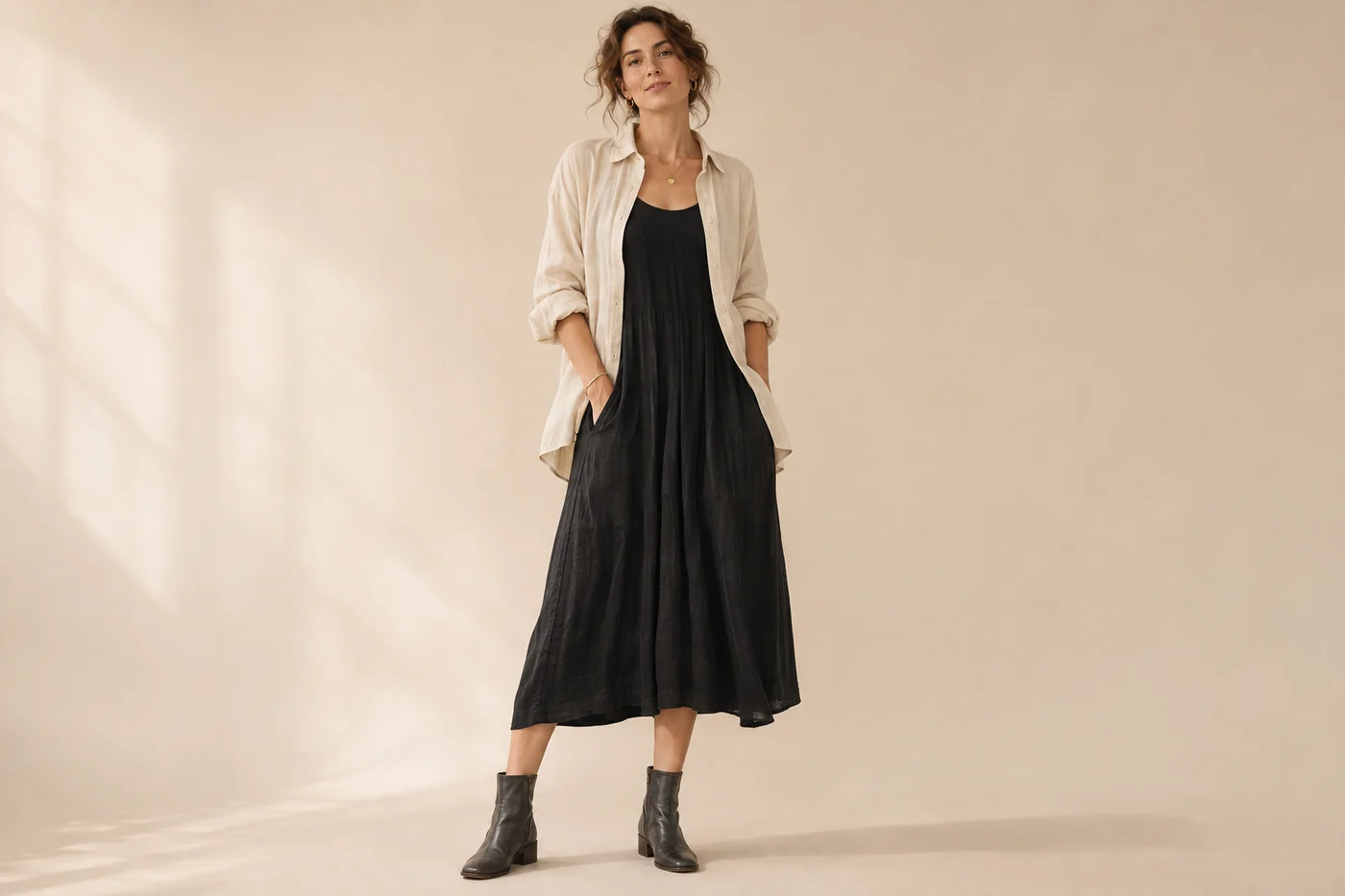
A blazer can give a dress or skirt a defined shoulder, lapels and an outer frame. Its length matters in relation to the lower garment, not as a universal measurement. A short jacket above a full skirt and a long jacket over a straight dress are different useful outlines.
Begin with the dress or skirt already working as an outfit. Then add the blazer and check what it changes at the shoulder, waist and hem. You can decide how formal the result should feel by choosing its partners and the actual setting.
Decide whether the blazer is a frame or the main shape
An open blazer lets the inner outfit remain visible through the center. A fastened blazer becomes a more continuous main top. Try both if the jacket is designed to close comfortably, and include the side and back view. The jacket may sit differently over a dress waist tie than over a plain skirt waistband.
Do not tighten the fastening to create a waist that the jacket does not naturally have. Reach forward and sit before deciding how you will wear it. A blazer can be relaxed or close-fitting, but the chosen layer should still permit the movement and coverage you need for the day.
Long blazer with a straight dress
Try a long gray blazer over a plain navy straight midi with dark loafers. The dress gives a quiet inner column; the jacket adds side panels and a shoulder boundary. Leave the front open for the first version so the dress neckline and continuous color remain readable.
Compare the jacket hem with the dress's widest or most detailed area. A hem ending above a slit, a seam or a gathered section may draw attention there. That can be deliberate. If the outfit feels too continuous, compare a lighter tee-like neckline under the blazer or a shorter jacket before adding a belt or several accessories.
Short blazer with a full skirt
Try a waist-length dark blazer, cream plain top and full navy midi with flat Mary Janes. The shorter jacket reveals the beginning of the skirt's width. The cream top can remain a small center panel rather than extending well below the blazer and creating another large horizontal strip.
If your blazer is longer, you can still use it. Compare it open with a tucked or shorter base, so the skirt waist appears in the center even when the jacket covers it at the sides. This gives you another way to frame fullness without assuming that every full skirt needs a cropped jacket.
Relaxed blazer with a slip-style dress
Try a dark brown blazer over a black slip-style midi and low black shoes. The jacket introduces a more defined shoulder around the dress's simpler neckline. A thin visible strap and a broad lapel create contrasting shapes; you do not need to add a necklace to make them belong together.
Check the dress straps and any underlayer beneath the jacket. If the dress pulls when you move, resolve the base fit rather than relying on the blazer to hide it. A jacket that you might remove is a real removable layer, so the dress should provide the coverage you want independently or with an intentional base beneath it.
Blazer with a short skirt: compare the two hems
Try a navy blazer with a gray short skirt, a plain dark crewneck and the shoes suitable for your day. The amount of skirt visible below the jacket affects how the lower outfit reads. A long blazer can cover much of the skirt; a shorter one reveals a clearer separate lower shape. Choose the version you actually intend.
Check the outfit seated and from the back, including the effect of carrying a bag or raising an arm. A standing front image is incomplete information about coverage. You can choose tights, a longer skirt or a different blazer length according to your needs. There is no fixed amount of visible skirt that makes the combination valid.
Set the level of formality through the whole outfit
A plain tee and low sneakers can make a blazer-and-skirt combination feel more everyday, while a collared shirt and a more restrained shoe can change the tone. Those are editorial associations rather than a dress-code guarantee. A particular workplace or event may have requirements that the outfit's visual language cannot settle.
Keep the blazer and lower garment fixed while swapping one supporting piece. For example, compare a cream tee and dark loafers with a blue shirt and the same loafers. You can see whether the collar supplies the difference you need before changing the shoe, bag and jewelry as well.
Test the outfit with its real outerwear
If you need a coat, try it over the blazer rather than assuming a coat that fits over a tee will accommodate the jacket. Check shoulders, upper arms and the way both hems fall. You may prefer a cardigan under that coat for this particular day, even if the blazer version looks right indoors.
Save the complete board with the dress or skirt, the base top where required, blazer and shoes. Add a note about whether the blazer is worn open or fastened. This makes the formula repeatable without confusing a dress-based outfit, which already supplies a connected base, with a skirt outfit that still needs a separate top.
Put the idea to work
Your wardrobe. Your version.
Sources and scope.
These combinations and styling examples are original editorial proposals. They are not a wear test, a statement of product availability or a manufacturer’s fit recommendation.
What this article can establish
- Outfit formulas are editorial proposals, not photographs of exact purchasable sets or results from a wear test.