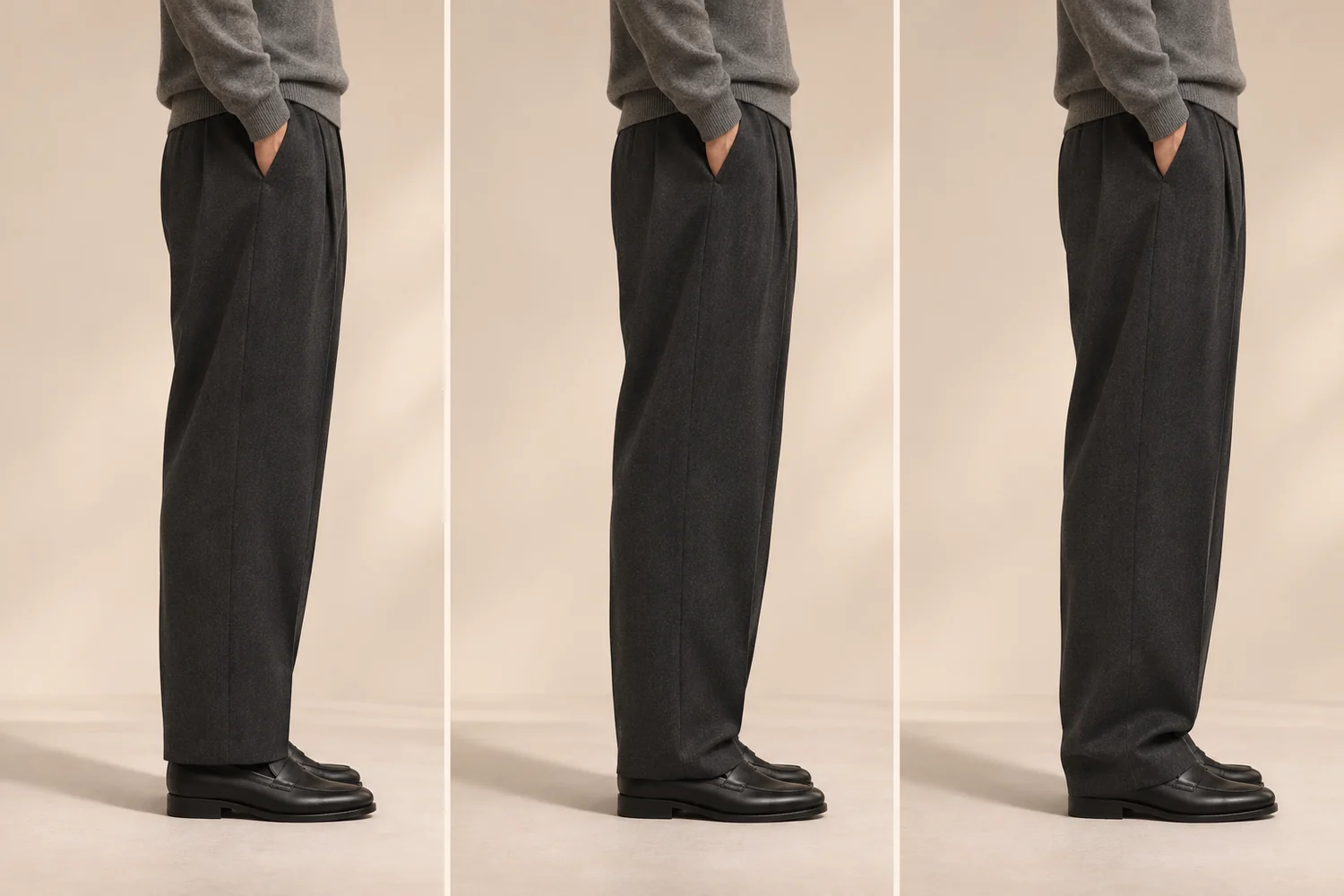
A break is the fold where trousers meet the shoe
Trouser break describes the bend or fold that appears when the hem rests on the shoe. It depends on the trouser length, the opening and the shape of the footwear. A size label or inseam number alone does not describe the fold you will see.
Proper Cloth explains the terms using dress shoes and notes that lower-backed footwear changes where the hem meets the shoe. Use the diagram as a vocabulary aid, then inspect your own combination rather than trying to reproduce an exact measured drop.
Compare no break, a small break and a fuller break
With no break, the leg falls with little or no fold at the front where it approaches the shoe. A small or half break introduces a visible bend. A fuller break leaves more fabric folding above the shoe. The labels describe a visual effect; they are not precise fractions of a fixed length.
None is automatically the correct choice for every outfit. A cleaner hem can reveal a slim shoe, while a modest fold can suit a softer or broader trouser line. Keep the same trousers and shoes in the comparison so you can judge the change in length.
Separate a deliberate fold from fabric catching
A hem can gather because it is long, but it can also stop against a boot shaft or a narrow part of the opening. If fabric piles above one point and drops when you release it by hand, inspect that obstruction before asking for a shorter inseam.
Look at the front, side and back. A pleasing fold at the front can coexist with fabric dragging behind the heel. Walk a few steps, turn and sit before deciding the static view tells the whole story.
Change the shoes before committing to an alteration
Put on the shoes you expect to wear most often with the trousers. A higher upper, a fuller toe or a different heel shape can make the same hem settle differently. If you alternate between two very different pairs, decide which relationship matters most for this garment.
Take those shoes to an alteration appointment and describe the visible result you want. Temporary pinning can help compare options, but leave permanent cutting or hemming to a method suited to the garment construction.
Use three catalogue outfits to decide what to inspect
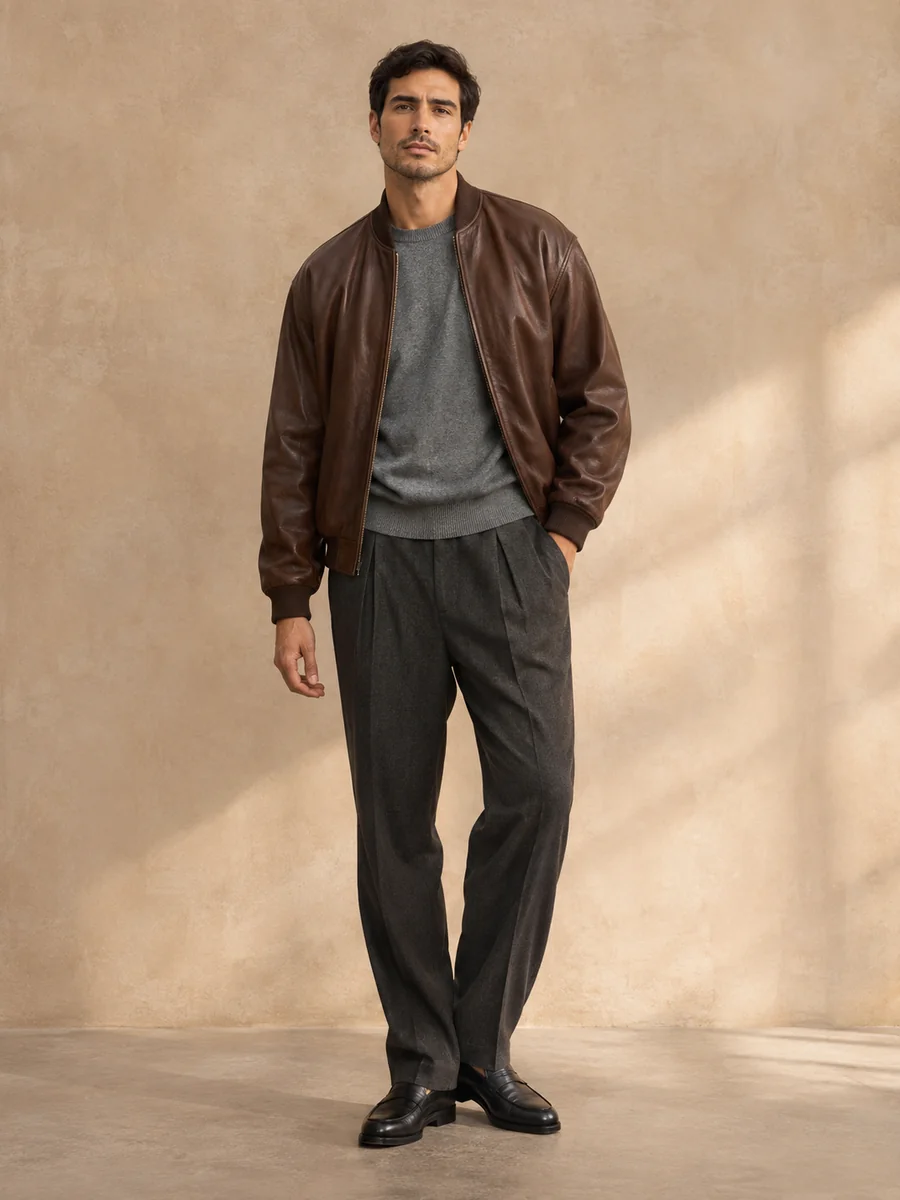
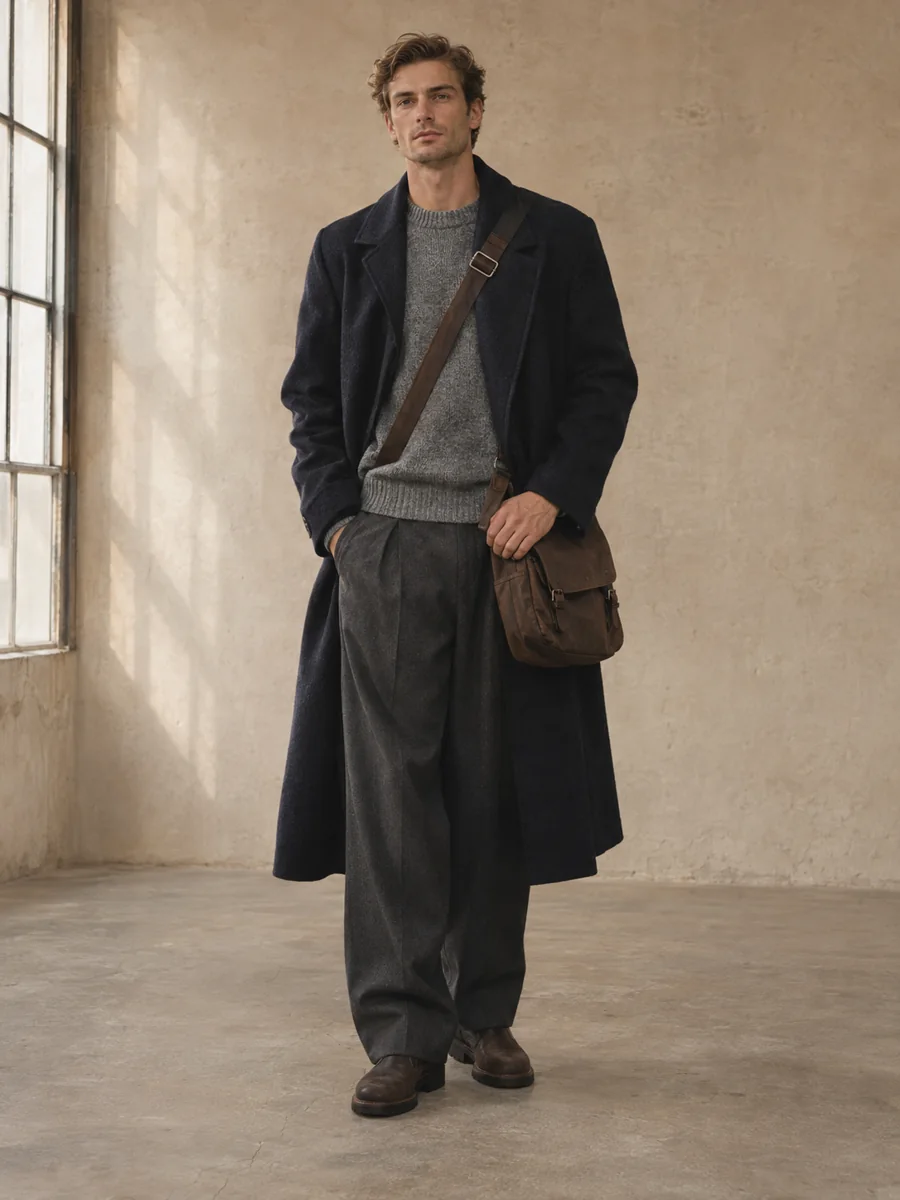
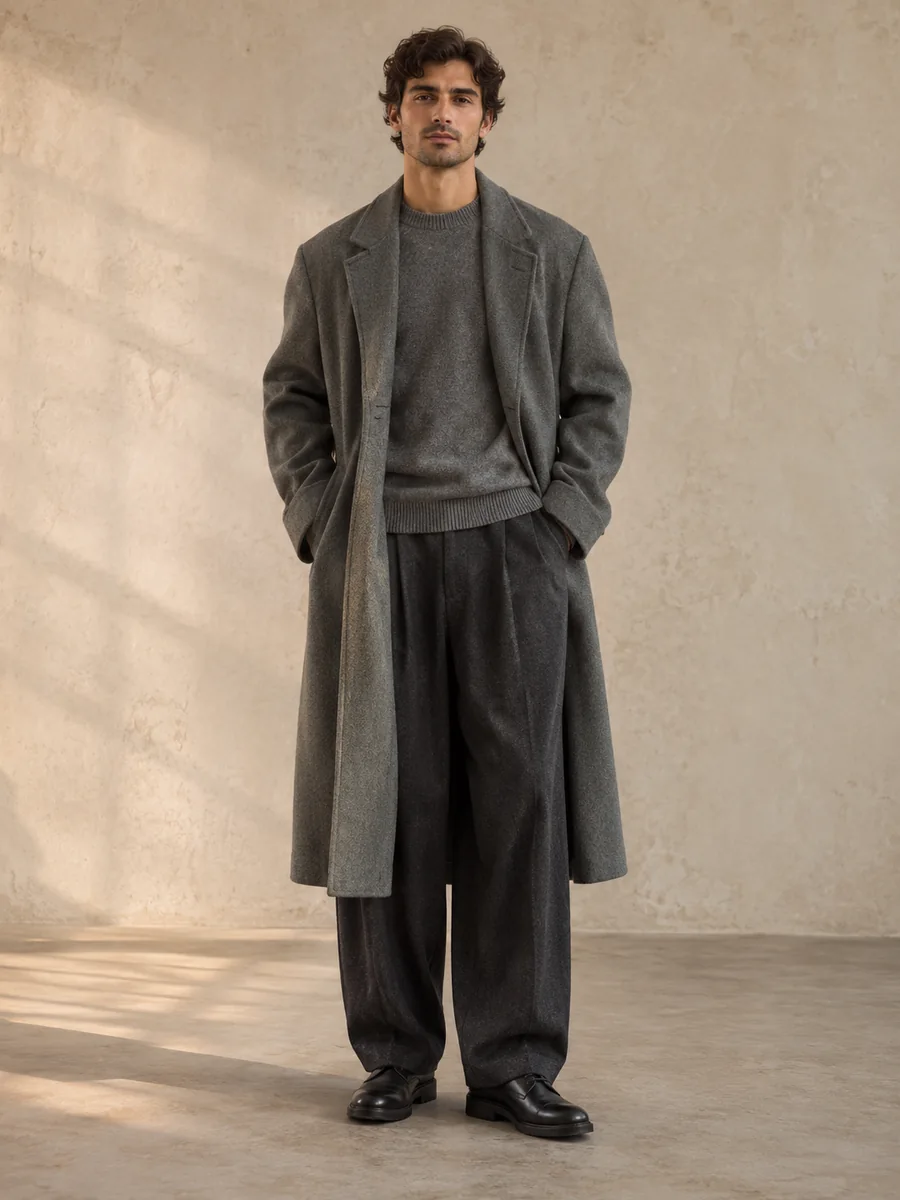
Brown bomber with charcoal pleated trousers pairs pleated charcoal trousers with loafers; Long navy coat with wide charcoal trousers puts wide charcoal trousers above plain ankle boots; Grey knit, charcoal trousers and a long grey coat combines broad charcoal trousers with plain-toe shoes. Their footwear and outer layers differ, so they are not a controlled proof of trouser length. Instead, use each composition to identify the relevant question before trying the exercise with your own pair.
With the loafer version, inspect how much of the low upper remains visible. With the boot version, check whether fabric is resting on the upper or catching at the shaft. With the plain-toe version, look for a front fold and then check the back clearance separately. These are observations to make, not an instruction that one of those outfits must have a particular named break.
Once you know what to inspect, hold the rest of your own combination constant. Arrange a temporary cleaner hem, compare it with the original length and move around in both. If the preferred effect only appears while you lift the waistband, it does not yet describe a stable hem choice. Resolve that waist position before using an alteration to fix the lower length.
Record the useful comparison
A photograph from a consistent distance can help you compare two temporary arrangements. Keep your normal waist position and stance. A change in camera height or a pulled-up waistband can make a length look different without showing how you will actually wear it.
In your outfit note, record the shoes and hem effect together. A note such as “small front fold with these boots, back clear of the ground” is more reusable than a length copied from another person.
Measure the opening before comparing the number
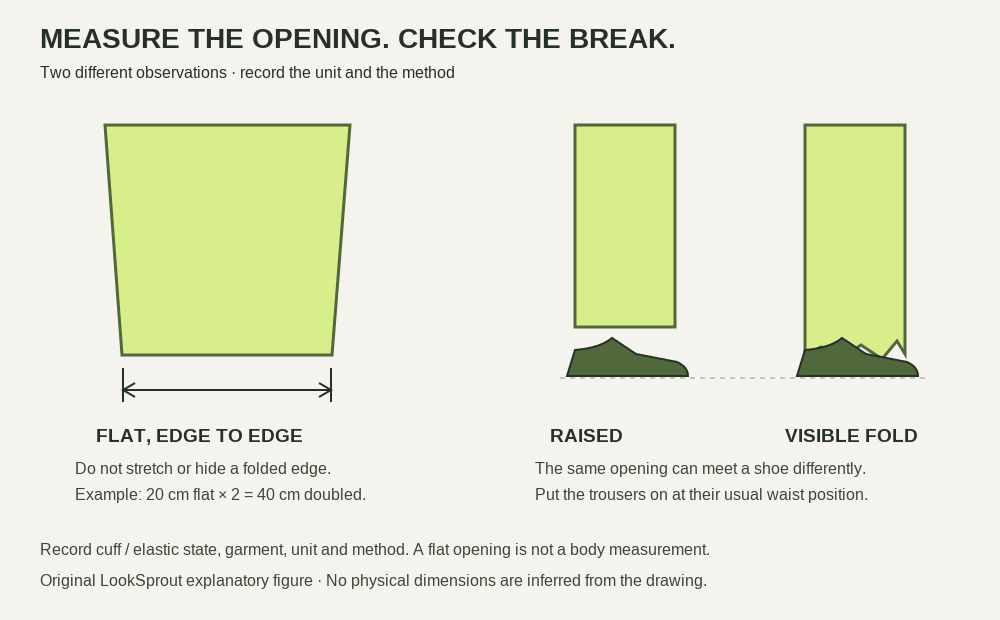
Place the actual trousers on a flat surface and arrange the lower leg without stretching it. Follow the seller’s specific method when comparing with a product chart. For a flat-width record, measure straight across the finished hem from one outer edge to the other and keep the tape at the hem. Write the unit and the words flat leg-opening width beside the number. Repeat the reading after checking that a fold has not hidden part of the edge.
Some retailers publish the flat width; others double it and call the result the leg opening. Proper Cloth shows an edge-to-edge flat method, while Skate Warehouse explicitly doubles its measured width. A figure called opening is therefore incomplete without its definition. As an arithmetic example only, 20 cm across the laid-flat opening becomes a doubled figure of 40 cm. Neither number is a body measurement or a recommendation for your size.
If the hem has a fixed cuff, a drawcord or elastic, record that construction and its state. Do not pull it wider unless the comparison method asks for a stretched measurement. A cuffed opening and an uncuffed opening are different records. Leave an unknown value blank instead of estimating it from the lookbook model or from a shoe’s apparent width.
Use the number to compare like with like, then put the trousers on with the actual footwear. A flat opening does not predict the fold on its own: length, rise position, fabric behavior and the shoe upper also matter. Keep those relationships visible in the tool. A wider recorded opening is not automatically a better match for a visually fuller sneaker.
| Record | Example only | Meaning |
|---|---|---|
| Flat leg-opening width | 20 cm, edge to edge at the finished hem | A width of one flattened leg opening |
| Doubled opening figure | 40 cm, calculated from the same width | Two times the flat width under the stated convention |
| Unknown opening | Blank | No measurement inferred from a photograph |
| On-body break | Small front fold with these shoes | A visual observation, not a fixed centimetre fraction |
Make the hem comparison reproducible
Choose one trouser, one shoe and your normal waistband position. Record the flat opening separately from the on-body hem effect. Compare a temporary cleaner hem with the original length, keeping the same stance and viewing distance. Inspect the front, side and back, then walk and sit. If the waistband or cuff slips during the comparison, reset it before deciding the change is repeatable.
Save a practical note with the actual wardrobe item: for example, straight leg, small front fold with the dark runner, back clear of the heel. Keep the public concept as an inspiration reference if it helped you name the relationship. A useful record explains what you changed and what remained constant; it does not claim an alteration result for every body, fabric or sneaker family.
Sources and useful references
Explore more outfit ideas or compare the style files.