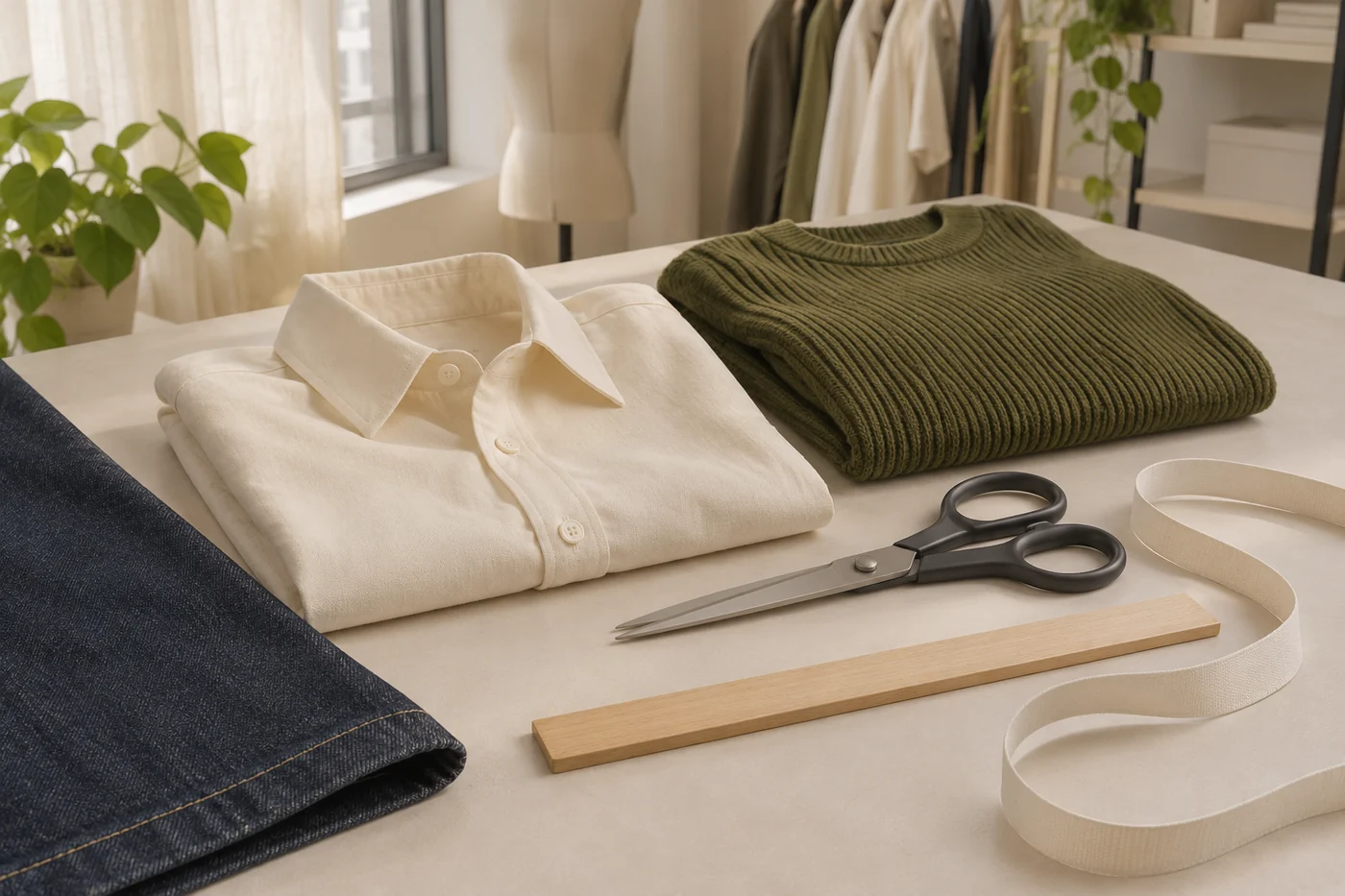
A useful alteration appointment starts with the change you want in daily wear: a hem that clears a shoe, a sleeve that stops catching your wrist or a waistband that sits more comfortably. You do not need to arrive with a technical diagnosis. Bring the real garment and explain the problem in ordinary language.
The tailor needs to inspect construction, fabric condition and the material available inside the seams. A flat measurement or photograph can help start that conversation; neither establishes what can be changed, how much it will cost or whether the result will retain the intended proportions.
Bring the whole fit situation
Wear or bring the shoes and underlayers you plan to use with the garment. For trousers, a different shoe profile can change where the hem rests. For a jacket, the shirt or knit underneath changes the space you need. Explain whether you intend one specific outfit or a broader range of uses.
Try the garment standing, seated and moving as you usually do. Describe when the issue occurs. A waistband that feels comfortable standing but restrictive seated is a more useful observation than a demand to remove a fixed number of centimetres. Ask which change would address the problem and what other part of the fit it might affect.
Use measurements as a reference, not an instruction to cut
Bring a garment you already like if its construction and purpose are reasonably comparable. Record how you measured it: flat waistband width, inside-leg seam or sleeve length from the stated start point. Keep the unit visible. A body circumference and a flat garment width belong to different comparisons.
For example, you may like the hem position of one pair of trousers but need more thigh room in the pair being altered. Say which feature you want to borrow. Copying every dimension would erase that distinction. Let the tailor assess where a similar effect is possible on the actual pattern and construction.
Ask what the existing construction permits
Proper Cloth publishes alteration guidance for its own tailored jackets and trousers, with ranges that vary by dimension and warnings that the garment and tailor affect feasibility. Its table is evidence that different areas have different limits, not a universal allowance you can transfer to another brand.
Ask to see the relevant seam allowance or hem reserve, where practical. Discuss nearby pockets, linings, vents, buttonholes, zips and decorative details. Ask whether shortening changes their position or whether taking in one area affects balance elsewhere. The visible outside shape does not reveal every constraint hidden inside the garment.
Separate straightforward goals from ambitious reconstruction
A proposed hem adjustment and a proposed shoulder reconstruction should not be treated as equivalent requests just because both involve a shorter number. Ask the tailor to explain the scope, expected appearance and any uncertainty before work begins. It is reasonable to decline a change when the trade-off is larger than the original fit problem.
Imagine a jacket whose body length you like but whose sleeves cover your hands. Discuss sleeve length specifically, including the cuff construction. Do not assume the answer from a photograph of the button placement. The tailor may need to inspect the inside or propose an alternative. Record the recommendation in words you can understand.
Agree the result before agreeing the work
Ask for a written description of the requested work, the quoted amount and the expected completion date. Clarify whether a fitting is included and what happens if the proposed change proves unsuitable during inspection. These are questions for that service, not promises that every tailor follows the same process.
If the garment will be cleaned first, follow its label and discuss the sequence with the tailor. Avoid applying a new washing process simply to prepare it. Tell the tailor about any known shrinkage, previous alterations or repaired areas. Missing history can remain unknown; guessing gives the person doing the work less reliable information.
Check the returned garment in the intended outfit
At collection, try the garment with the same shoes and layers used for the assessment. Look at both sides, walk and sit. Confirm the agreed change and inspect nearby details. A neatly finished seam is valuable, but it does not by itself establish that the new shape suits your intended use.
Update the garment’s measurement and alteration note after the work is complete. Preserve the earlier values as history rather than overwriting them without explanation. A useful record says what changed and when. It can inform a future purchase or repair conversation while remaining specific to this physical garment.
Put the idea to work
Your wardrobe. Your version.
Sources and scope.
What this article can establish
- No feasibility, price or fitting result is inferred from a photograph. Published Proper Cloth alteration ranges apply to its garments and are not reproduced as universal limits.