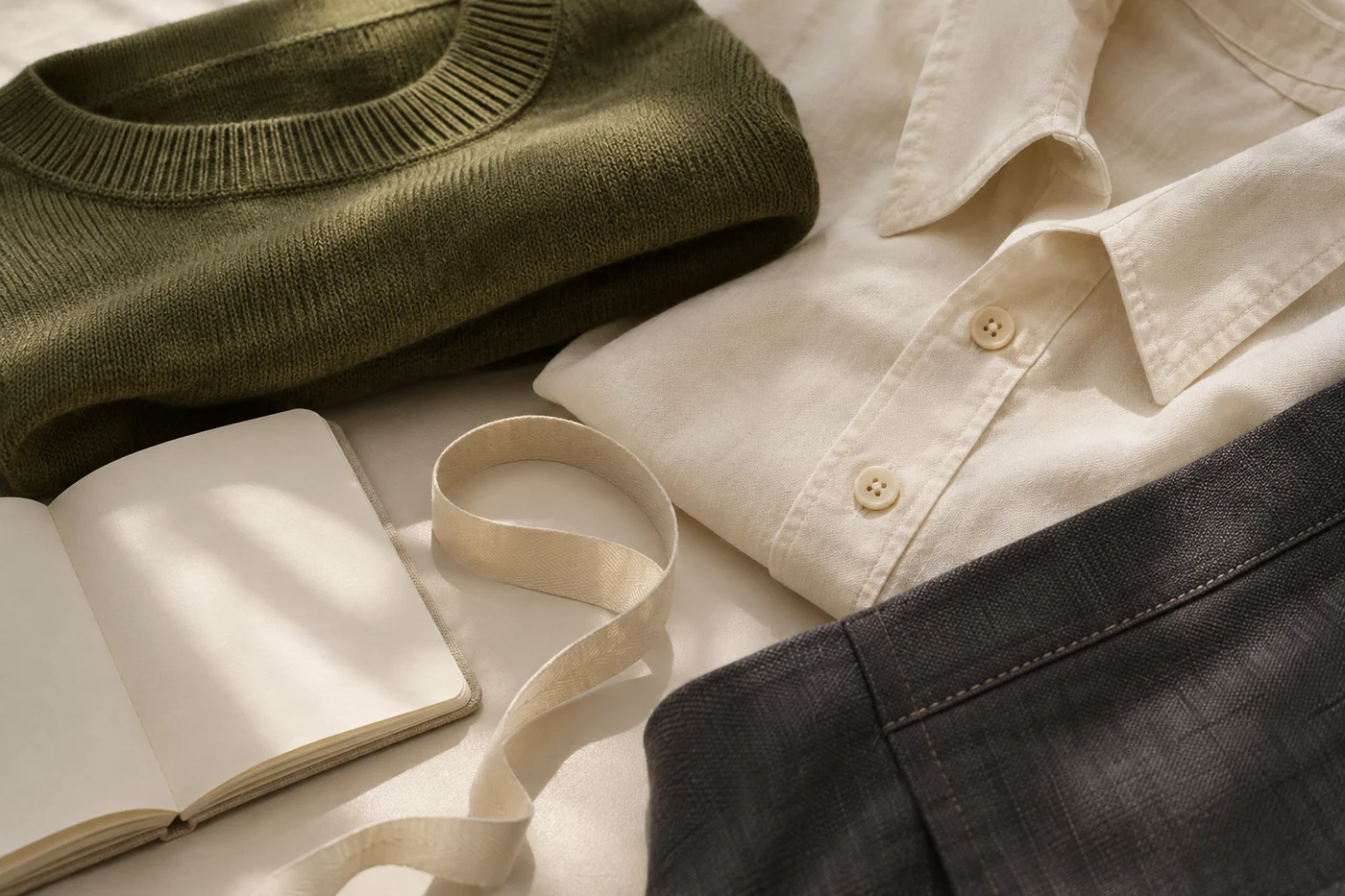
Knit and woven describe fabric construction, while cotton, wool and polyester describe fibre ingredients. Knowing both helps you read clothing more clearly. A cotton garment can be knitted or woven, and a similar-looking silhouette can use different constructions.
The basic distinction is simple: knitting builds fabric from interlocking loops, while weaving interlaces sets of yarns. The result still depends on yarn, structure, finishing and garment design. Use the distinction to ask better questions about an actual piece, not to assign every knit or woven the same stretch, warmth or formality.
Read the yarn paths in a simple weave
CottonWorks’ weaving explanation describes lengthwise warp yarns and crosswise weft yarns interlacing to form fabric. Plain weave, twill and satin are different weave structures. In a simple plain-weave diagram, the crosswise yarn passes over and under alternating lengthwise yarns.
That diagram is a structural explanation, not a photograph of every woven fabric. A fine cloth can be difficult to read at normal viewing distance, and a surface pattern may come from color or finishing instead. Use the manufacturer’s fabric description when available rather than diagnosing construction solely from a distant product image.
Read the loops in a knit
The National Cotton Council describes knitting through interlocking yarn loops and identifies lengthwise loop columns as wales and crosswise rows as courses. Knitting includes more than one structure; CottonWorks also distinguishes weft and warp knitting in its educational material.
A visible rib-knit cardigan is an accessible example when its construction is confirmed. A fine jersey tee can also be knitted without looking like a chunky sweater. Thickness and the everyday word knitwear therefore do not reliably separate every knitted garment from every woven one.
Keep fibre and construction as two fields
CottonWorks’ material library includes examples of cotton jersey, cotton rib, cotton twill and cotton Oxford constructions. The shared fibre label does not make those fabrics identical. Record the ingredient and the construction separately when the product supplies both.
For a hypothetical comparison, consider a cotton jersey tee and a cotton plain-weave shirt. Their neckline, closure, cut and fabric structure all differ. If one feels closer or hangs differently, you cannot assign the entire difference to cotton, because cotton is the common ingredient. Keep the garment-level details in the comparison.
Do not turn construction into a stretch promise
Looped structure helps explain why some knits can change shape as their loops move, but it does not establish an exact stretch or recovery for every knitted fabric. Woven clothing can also contain elastic fibres or use construction and cut to create movement. Read the exact description and assess the actual garment.
If stretch matters to a purchase, look for documented information and compare a reference with a similar intended use. A flat width from a close jersey top is not enough to select the size of a woven overshirt. Body room, fastening and layering requirements remain important even when the numeric width looks familiar.
Use construction to understand a styling choice
A confirmed fine-knit cardigan can provide a softer-looking upper outline beside a structured trouser. A crisp-looking woven shirt can give a clearer collar and hem boundary above a skirt. These are possible styling relationships, not fixed properties of all knitted and woven fabric.
Try the actual piece open, closed, tucked or loose as relevant. A bulky knit may gather at a waistband, while another knit is fine enough for the tuck you want. A fluid woven shirt can drape more softly than a dense knit. Describe the result you observe rather than forcing the garment to match its category stereotype.
Keep the care label in charge
Construction knowledge can help you notice a snag, an unstable edge or an area under strain, but it does not supply a universal wash method. Use the garment’s care instructions, including any separate guidance for trims, lining or finishes. A woven wool garment and a knitted cotton garment do not inherit one shared care recipe from those broad categories.
If you are unsure about an unfamiliar structure or damage, preserve that uncertainty and seek guidance for the exact garment. Do not pull hard on a fabric to prove whether it is knitted or woven, and do not treat an experimental stretch as a performance test.
Make a small construction record
When comparing garments, record confirmed fibre, confirmed construction, visible surface and unknown fields separately. Keep that record in a private note and add the manufacturer source when one supplies the information. A statement such as cotton, rib knit, close-cut top is more useful than soft fabric when you later compare another piece.
Use original diagrams of a plain weave and a simple knit to learn the yarn paths, then return to your real clothing. The categories provide a vocabulary for asking questions. The useful final decision still depends on the dimensions, details, care and appearance of the garment you intend to wear.
Put the idea to work
Your wardrobe. Your version.
Sources and scope.
- CottonWorks: Weaving Basics
- National Cotton Council: Fabric Manufacturing
- CottonWorks: Knit Basics
- CottonWorks: Material Library
What this article can establish
- CottonWorks definitions and construction examples were available through official indexed text; direct retrieval returned access restrictions. The National Cotton Council page was directly accessible.