Choose the cost you are measuring
Start with the amount and currency you actually know. Decide whether your figure means purchase price alone or includes a stated repair or alteration. Keep that choice visible so that later comparisons use the same basis.
Do not combine amounts in different currencies as if they were one total. If the original cost is unknown, leave it unknown or clearly label an estimate. An old garment does not need a made-up purchase price to belong in your wardrobe.
Divide by confirmed wears
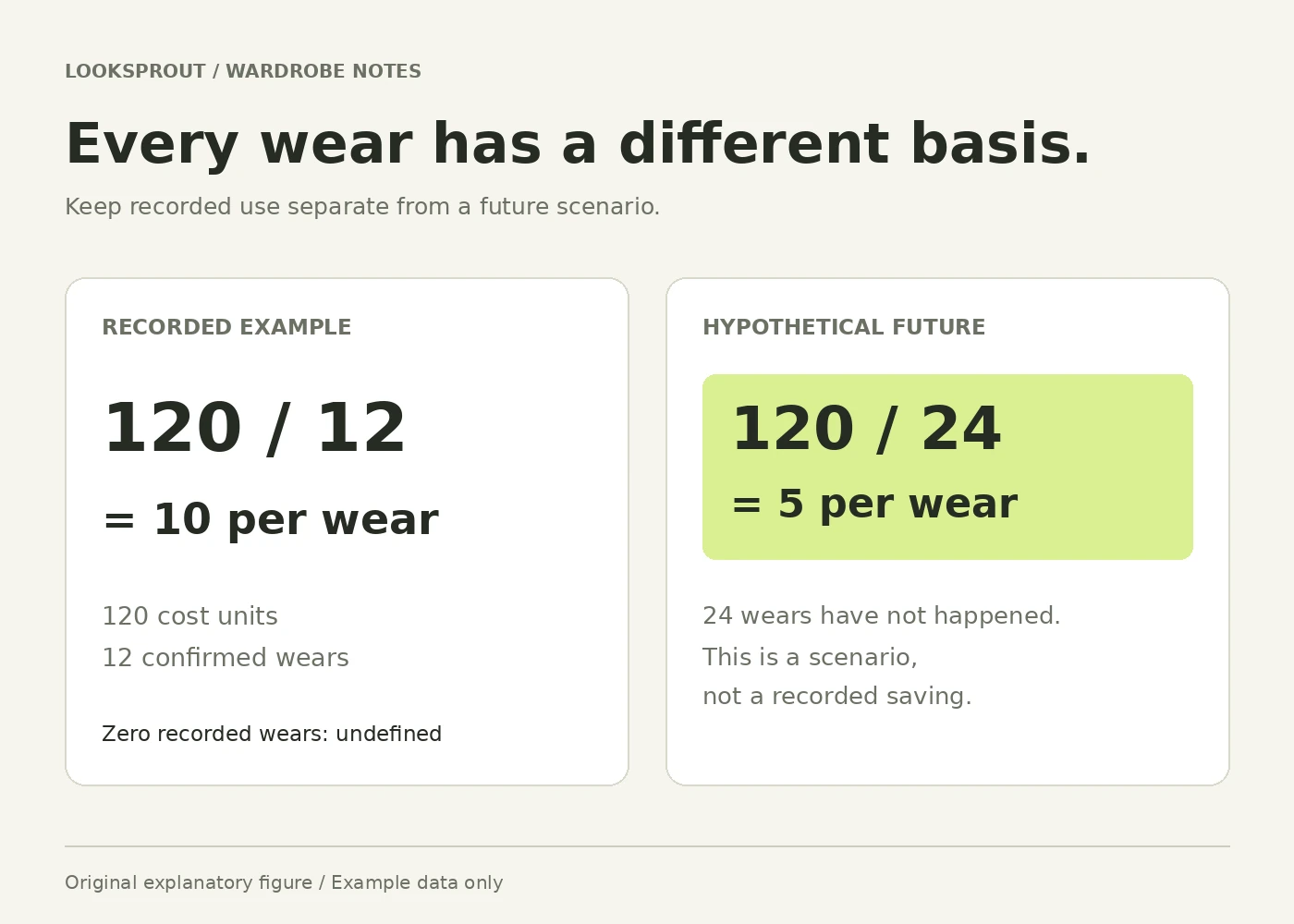
For a simple example only, a garment costing 120 units with 12 confirmed wears has a recorded cost per wear of 10 units. With zero recorded wears, this calculation is undefined; it is not a zero cost per wear.
A scheduled outfit is not a confirmed wear. If you started recording recently, your result describes the recorded period rather than the garment’s entire life. Label an incomplete history instead of filling it with invented uses.
Keep a future scenario separate
You can explore what the figure would become after more wears, provided those wears are clearly hypothetical. That scenario may help you think about use, but it is not an observed result or a reason to promise a saving.
The calculation also does not measure comfort, quality or whether you need the garment. A low number can reflect frequent use; it cannot make an unsuitable purchase useful on its own.
Use the result to ask a better wardrobe question
Look at a piece you enjoy and the situations in which you reach for it. Then inspect an item with fewer recorded uses. It may need a different partner, a repair, another season or simply a fuller record.
Keep the amount, currency and wear basis attached to the physical garment. This makes the result understandable later, when prices change or a planned outfit becomes a confirmed one.
Bring the physical piece into the calculation
Open the cost-per-wear calculator from a saved wardrobe piece when you want to use its recorded amount. Check the currency and the wear basis before accepting the result. A baseline you entered for earlier use stays distinct from dated journal entries. Changing a planned outfit should never add another wear to either number.
If you later correct the cost or remove an accidental journal entry, calculate again from the corrected records. Keep a short note about an estimated baseline if you want to understand it months later. Exporting a backup preserves your local records; it does not verify them independently or turn a projected figure into an observed one.
Explore more outfit ideas or compare the style files.